Seattle Food Co-ops Merge, Give Workers a Share
On Monday, the Capitol Hill co-op will make a variety of major changes to its business, including the solidarity shift. Employees will own 50 percent of Central Co-op and members will own the other 50 percent after the shift. Central Co-op is already a one-person, one-vote co-op.
 Our work at NEC is based on the idea that our efforts to build a New Economy are most successful when we work collaboratively, building power across sectors and movements.
 In line with the Summit's overarching theme, this scientific conference aims to bring together scholars and practitioners around the impacts of cooperatives.
 Three of their staples are the Sun Eater, a sorghum ale gruit with rosemary; the Long Walk, an American-style grapefruit IPA; and the tamarind-infused Renewal. Currently a chamomile cream ale is ready to go, and a bourbon spiced ale aging in Banner Distillery whiskey barrels is on deck. Those unique flavors are purposeful – and are local in more ways than one.
 The conversion process won’t be easy. Dubrow and the company’s future owners have a lot of details to work out, such as how much it will cost to buy an ownership share, and how the cooperative will buy Dubrow out when he retires.
 by Marcelo Vieta
 PROSOCIAL is an internet platform that can be used free of charge to help almost any group improve its performance. It provides a group with its own home page and a training course based on scientifically validated design principles.

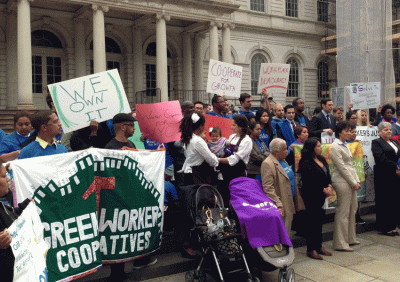 Worker cooperatives can sometimes sound too good to be true: a business owned and controlled by its workers, who each usually get an equal share of the profits. Compensation for some has gone from $6.25 an hour to $25 an hour. Flexible schedules.
 Roots Coop provides housing and common ownership opportunities for activists from several affinity groups in St. Louis, MO.
 As cities wrestle with the growing challenge of wealth inequality, more and more leaders are looking to broad-based ownership models as tools to create jobs and build community wealth. These models are highly effective, with a positive impact for low- and moderate-income individuals and communities.