
Cooperatives operate successfully in competitive markets. Member ownership often confers distinctive advantages in knowing how to offer products and services that appeal to customers. When investor-owned firms (IOFs) compete with one another or with cooperatives it is the usual market contest of who provides better products and services to consumers. However, when cooperatives begin to provide superior service and expand their market shares, IOFs may avail themselves of two general strategies for diminishing the cooperative impact: (1) lobbying for policies and regulations that are unfavorable to cooperatives, and (2) selective pricing to diminish or undermine the solidarity of cooperative members.
Lobbying for unfavorable regulations is frequently carried out against credit unions and rural electric cooperatives when they have increased their market shares. In regard to the second strategy, solidarity is less of a critical issue for credit unions and rural electrics as it is for other types of cooperatives. This article discusses the two strategies IOFs use with examples from their competition with farmer cooperatives.
Emergence of Farmer Cooperatives
A movement for farmer cooperatives started in the Midwest and Plains States after the completion of transcontinental railroads in the mid-19th century. The railroads initially involved slight economic returns from running through sparsely populated territories. Consequently, railroad companies provided immigration for large numbers of farmers from Europe, mostly from Germany and Scandinavian countries. The companies sent agents to Europe who provided immigrants with the legal papers and transit for getting to North America.
As farming expanded, the railroads, bankers and agribusinesses charged high prices for services and paid low prices for farm products. The Grange was one of the early farmer movements that sought to improve the economy for farmers in the late 19th century by organizing local cooperatives. Although there are no statistics on cooperatives until 1913, there were 3,099 in that year, and there were likely very few prior to transcontinental rail transportation. They significantly increased to 12,000, their highest number, by 1929.
Cooperatives improved the returns to farmers over what they could do operating on their own. When they increased their market share, agribusinesses competitors resorted to antitrust lawsuits and lobbying for unfavorable cooperative taxation.
Antitrust
In the 1890s, the Farmers Alliance, like the Grange, developed cooperatives, including strategies for large scale price coordination. The Alliance inspired other efforts to coordinate the pricing of large volumes of commodities from many farmers but were defeated by antitrust laws. In 1922 the US Congress passed the Capper-Volstead Act that provided cooperatives with limited immunity from antitrust. In exchange for this immunity cooperatives must adhere to: (1) agreements on prices can not include an amount in value from non-members greater than that from members of a cooperative. (2) one-member, one-vote and (3) dividends must not exceed 8%. Despite the requirement of satisfying these principles, lobbying to overturn Capper-Volstead has persisted over time.
IOFs have enervated the enforcement of antitrust on their industries over the past sixty years or longer. Efforts to diminish antitrust regulations have involved firms in several industries outside of agriculture. Nevertheless, exemptions to antitrust similar to those provided by Capper-Volstead have stood out as a benefit that IOFs have long sought to acquire.
Taxation
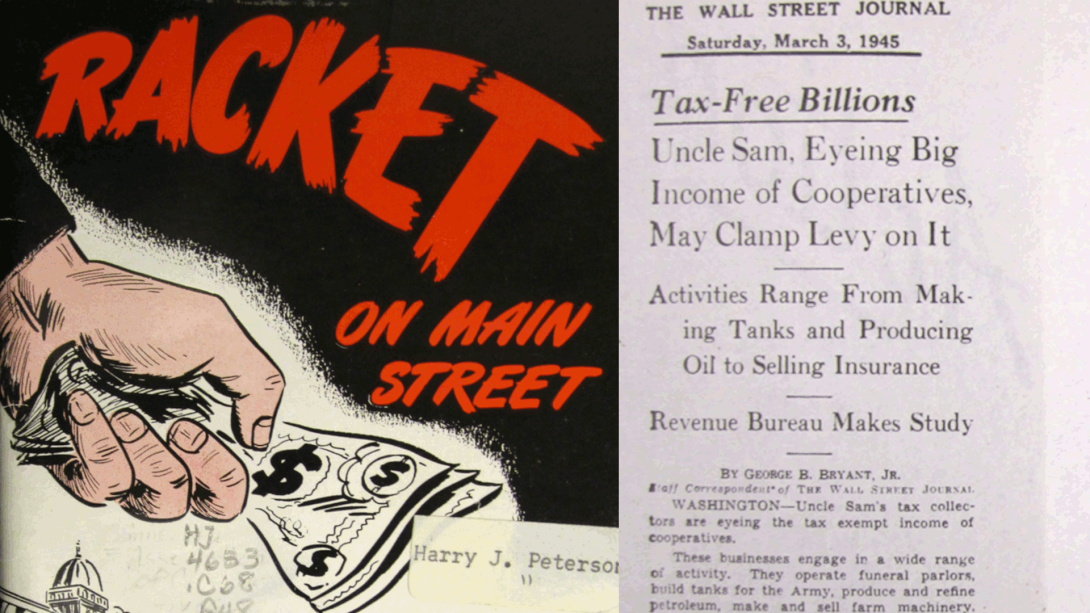
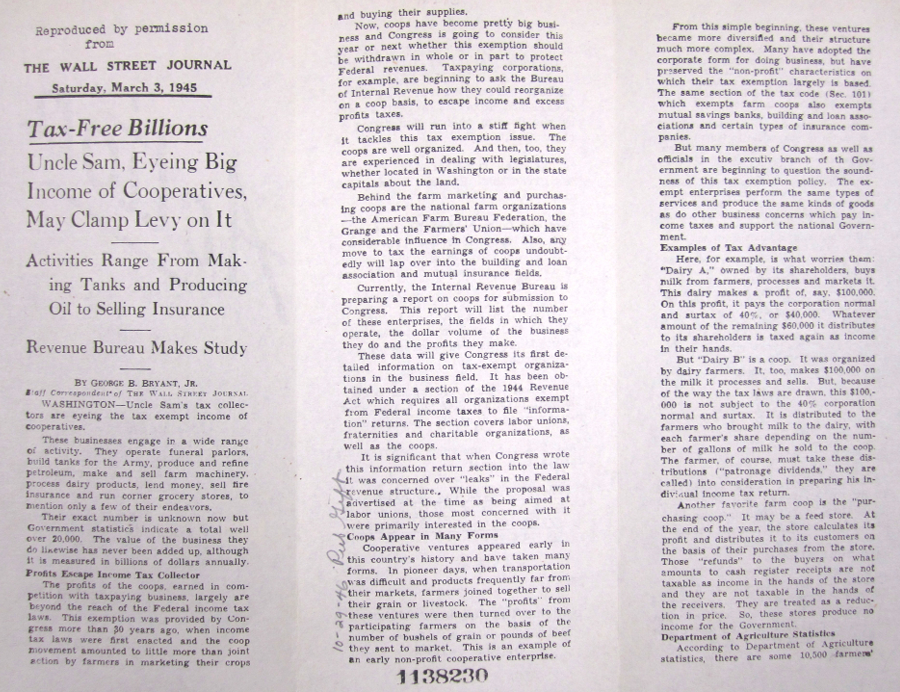
An important policy provision for how cooperatives are formed and taxed is Sub-Chapter T of the Internal Revenue Service (IRS) code. Enacted in 1962, Subchapter T provides for taxation to apply only to members but not to their cooperatives. It basically codified a practice by cooperatives that had been legally recognized in IRS rulings for several prior decades. The rational for only taxing earnings allocated to members as equity is that it is designated for distribution and not held by a cooperative as permanent capital. Cooperatives are, however, taxed on retained earnings that are not allocated to member equity.
This single taxation status of cooperatives was aggressively criticized by investor-owned firms who established the National Tax Equality Association to lobby for the repeal of Subchapter T. After a couple of decades, the National Tax Equality Association ceased to exist. It changed course, seeking legalization for a single tax system that IOFs could use for subsidiaries or for new businesses. Limited Liability Companies (LLCs) emerged as a way to form businesses that avoid taxation except for shareholders who receive distributions.
Unlike LLCs, cooperatives are incorporated entities. Another difference is that an LLC may include a majority of investors with governance rights who do not use or participate in any way with the operations of the business. Cooperatives may finance their operations in part from non-member investment, or more recently, they can form a Limited Cooperative Association with investor members who are without majority control.
Case Studies of Diminishing Solidarity
In addition to the policy arena, IOFs have also used various marketing strategies in attempts to weaken solidarity and divide cooperative members. These tactics for weakening solidarity have persisted from the early period of farmer cooperatives to the present day. Two case studies demonstrate these strategies that were examined during recent decades by USDA/Cooperative Service.
In the 1990s, the Sooner Cooperative in Oklahoma experienced a sudden decline in membership. A survey was conducted by USDA/CS of growers who had stopped selling wheat to Sooner. Like other marketing cooperatives, Sooner informed members of the quality-price differentials for each season’s new crop of wheat. Members were paid a fair or equal price based on the quality of the grain they delivered. Members wanted this type of cooperative policy. Those with lower quality grain would not benefit at the expense of other members. It also encourages better production and handling processes.
One season had extreme rainfall during the harvest in a few locations of Sooner’s membership area. A multinational agribusiness firm reached out to members who had wet wheat. It offered to ignore the moisture discounts and won the future loyalty of those members. The agribusiness could afford overpayment for wet wheat because it procured large volumes from a wide geographic area for blending to commercially acceptable moisture levels. Such firms are also diversified and can “cross-subsidize” from other operating divisions.
In the early 2000s, an extreme undermining of cooperative solidarity occurred among California pear farmers. Some farmer cooperatives operate as bargaining associations, authorized to coordinate price offers to commodity processing companies by the Agricultural Fair Practices Act. The bargaining association negotiates a price that is acceptable to their members and to the processors. The demise of the California Pear Bargaining Association in 2003 is an example of exploiting diversity among growers.
Two characteristics of the California pear market created a latent instability for the bargaining association. (1) The climate and irrigation in California make it possible to have two harvests. The first produces pears suitable for the fresh fruit market while the second is late in the season with product that is best utilized for canning. (2) Pear growers were divided between those with relatively small acreage and a small group of large growers who operated packing sheds for marketing fresh pears. The grower-packers marketed the fresh crop for all farmers but were dependent upon the bargaining association for establishing a fair price for pears to be processed.
The lead canning company had hired a CEO who was a former manager of the bargaining association. The usual practice was to negotiate a seasonal price for pears to be delivered to the canneries. Grower-packers would wait until negotiations were completed and then deliver their second harvest for the negotiated price. Prior to negotiations in 2003, the lead cannery manager confronted the grower-packers with a low take-it or leave-it offer with only a few days to decide. Because they were not members of the bargaining association, they were unprotected from antitrust violations provided by the Agricultural Fair Practices Act. They could not confer among themselves or communicate with the bargaining association, so they opted to accept the low price offered by the cannery.
The lead cannery announced to the members of the bargaining association the low price that the grower-packers had accepted and that it would apply to all deliveries. They were told that the canneries would operate with just the pears from the grower-packers if necessary. The members accepted the low price and the bargaining association collapsed.
What Non-Agricultural Cooperatives May Confront
Non-agricultural cooperatives that have gained significant market shares in their industries have experienced lobbying to diminish the benefits of their regulations and tax policies. The strategy of undermining member solidarity has likely been experienced by those cooperatives as well. IOF competitors seek to identify diverse interests of members that can be targeted with offers that are unavailable from cooperatives due to their policies of fair treatment for all members.
As several cooperative sectors, such as worker owner, retail, and housing, experience a growing trend, competitors will lobby to diminish government policies that are favorable to them. IOF competitors will continue to seek regulatory treatment similar to cooperatives but without having to adhere to any type of democratic and fairness principles. Competitors of cooperatives can also be expected to search for ways to try to undermine member solidarity.
References
Frederick, Donald A. (1997). “The ABCs of LLCs.” Rural Cooperatives, July/August.
Frederick, Donald A. (2002). The Antitrust Status of Farmer Cooperatives: the Story of the Capper-Volstead Act. USDA, Cooperative Information Report 59.
Frederick, Donald A. (2005). “Subchapter T: Where We’ve Been & What is the Future.” Cooperative Accountant, Summer.
Lancieri, Filippo, Posner, Eric, & Zingales, Luigi. (2022). “The Political Economy of the Decline of Antitrust Enforcement in the United States.” National Bureau of Economic Research, Working Paper 30326.
Reynolds, Bruce J. (1997) Decision-Making in Cooperatives with Diverse Member Interests. USDA, RBS Research Report 155.
Reynolds, Bruce, J (2010). “Choosing to Defect from Cooperation—the 2003 Collapse of California Pear Bargaining.” Journal of Cooperatives, vol. 24, pp. 44-62.
Citations
Bruce J. Reynolds (2026). How Investor Owned Firms Compete With Cooperatives. Grassroots Economic Organizing (GEO). https://geo.coop/articles/how-investor-owned-firms-compete-cooperatives
Add new comment