
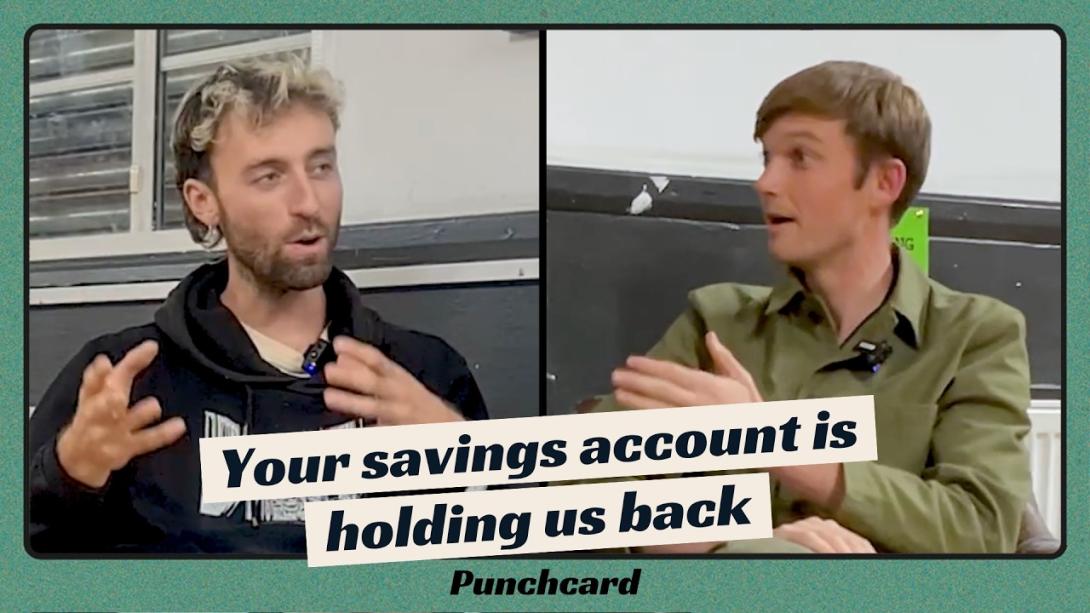
An Interview with Rob Callender
There are a couple of thousand people working in worker co-ops across the UK. Collectively, that represents millions of pounds sitting idly in separate bank accounts, where it’s used by banks to pay shareholders and invest in things many of us would strongly oppose.
What would it look like to pool more of that money together and use it collectively instead?
Some of us already use credit unions, community shares, or building societies, but these institutions can still feel distant and impersonal. They don’t bring people together and embed democratic culture and power in the way that worker co-ops do.
This month’s guest is Rob Callender, co-founder of Kin.coop, a platform designed to help people start and manage cooperative savings clubs. What would it look like to organise money collectively?
👉 Punchcard exists to help worker co-ops learn from each other and become stronger - support Punchcard on Open Collective and help us keep these conversations going.
Transcript
Rob Callender: I give this talk sometimes where I trick people into telling me what their financial situation is. And the largest room had nine million pounds, just in assets, just in the wealth of people sitting in bank accounts or in things that are liquid that they could sell immediately and it wouldn't affect the roof over their head. And for me, I find that fascinating because some of these rooms, they're like, "oh, wow, we didn't know we had nine million pounds between us." And they'd just been to a talk about trying to raise £20,000 to help buy a building like this that we're sat in: they didn't realize that they had that money.
And that suits the giant money hoovers, the big banks and the big asset managers and the people who wealthy people deposit their money with, because it keeps all of their money separate. I often say it in kind of hyperbolic way, but really I believe it. If we can't change that, I think we're fucked.
Caleb Elliott: Rob is one of the co-founders of Kin Cooperative, a digital platform re-imagining how we save money. In a traditional bank, we deposit our earnings and savings and they use them to create profit for their shareholders by investing in extractive, unsustainable and imperialist ventures. Kin offers a democratically controlled alternative, and removes shareholders so that your savings can be used to benefit you and your community.
Although it might sound similar, Kin isn't a building society or a credit union because its model is built around small, autonomous community savings clubs rather than a centralized institution. The vision is that the benefit of building these saving clubs is not only financial, but also social and cultural. This model was inspired by countless examples of saving clubs around the globe but by digitizing it, Kin aims to change our secretive and atomizing culture around money, and instead building a cooperative future where resources and assets are owned collectively, like Clapton CFC's Community Owned Football Grounds and Clubhouse, which is where we're recording this episode today.
I've been following Kin for a while. I'm very excited to speak to you further, Rob. So welcome to Punchcard.
Rob Callender: Thanks so much.
Caleb Elliott: Kin is a mixed membership cooperative made up of workers and users. Can you explain what it means to be a worker cooperative generally, and how kin fits into that definition?
Rob Callender: A worker cooperative is an organizational business social enterprise that is either wholly, or majority, owned and controlled by the people whose relationship with that organization is their labor. And Kin fits into that because the workers of the cooperative have 50 point a little bit percent of control over key decisions in the AGM. And the way we've done that is because we're a platform where... In an ideal world we'll have tens of thousands, and hundreds of thousands of users, and we might only have 10, 20 - at the moment two - workers. We need to balance those incentives, and also we believe that labor is the kind of engine of value creation anyway, and so we wanted that to be rewarded, but at the same time we also wanted to give the users of the cooperative, who are using it to save money, a stake in that.
Caleb Elliott: There's an interesting argument which worker co-ops skirt over a little bit: like, should we have more mixed co-ops, or is it fine to have that dedication to worker ownership 100%.
Rob Callender: Whether it should be 100% or not, I think it's too binary about where value is created, and especially from a feminist understanding of it. A lot of labor is not historically recognized as labor, which involves care work, and it involves composting[?], it involves mutual aid - and how do you figure that into labor, into worker co-operatives?
Caleb Elliott: Kin is such an ambitious project and it clearly draws on a wide range of skills and perspectives. How did your early experiences shape your approach and mindset that you bring to something like Kin? Big question.
Rob Callender: Yeah, it's a huge one. I was born in Japan and I grew up in Hong Kong, but my grandfather was a school teacher at a boarding school in the UK and my parents decided they were going to send me to a boarding school at an early age, because it would have been a bit of a "fuck you" to him if they didn't. And so they sent me to boarding school which at the time as an eight-year-old, I was really excited for because to me the UK was Narnia. If you grow up in hong kong snow is amazing. People having fireplaces is just completely insane, unless it's like an artistic piece that rich people have in their houses.
So to go to the UK felt really interesting and I kind of threw myself into it. I was quite an academic child, but by the time I was like 13, 14, it got pretty shit. And I went to a sort of senior school, a boarding school in the UK, and they're just awful places. I just don't think they should exist. And they breed a certain kind of awful, arrogant superiority that I think comes with this sort of sense of being elite.
But from the very beginning, I really rebelled against it. There was something about it where I just felt like people were behaving really badly, just in the sense of kindness. And the whole drive was, "you're going to go to university to make money, you're going go to the degree that's going to get you into the thing that's gonna make money" - and they literally had charts for trying to help you work out what your best probability was. And the parents took it super seriously. You know, that was what it was. They were kind of like, you know, investing in you becoming incredibly rich, and I just absolutely hated it, and had some awful times as well.
I'm gay and it was not hugely easy to be gay in a boarding school. That's a complete understatement. It was pretty awful but I think that as well polarized me a little bit. I was like, "okay this is wrong and I don't want to be a part of it," so immediately I was like, "I don't want to go to university," and the one thing I really liked doing at the time was acting, so I went off to an acting school became an actor. I had a couple years of acting that I really enjoyed, but similarly like that whole environment was about trying to get to the top as quickly as you can. And again, I'd always been interested in sort of the environment and ecological things. And that really woke me up. I just went, "what am I doing all this for? I can do this show, and then this, and then that," but something in me was saying, "at the end of the day, what does it all add up to? There's all these actors who've done all these things in the world - what is it actually doing when the world is falling apart?".
So I was working as a script doctor very briefly for a production company in London. It was kind of fun actually, I quite enjoyed it. And at the same time I was researching about climate change, and just to go beyond all of the damage - you now, the Amazon and all the obvious stuff about environmental destruction - into what's actually causing it? What do people think are the solutions? Why aren't we getting anywhere with it? And this was when I was like 20, 21, 22, 23. And the most obvious answer is capitalism: the whole economic system, the financial system.
And for me, there were a few key moments in my research that really uncovered that. And then I went to Paris for the Paris Climate Agreement for all the protests around that. This was the first time where I was like, "I'm gonna get on a train by myself, I'm going to join the crowd." And it was incredible, absolutely amazing. And I met all these people and I was suddenly like, "oh wow, there are loads of other people, who aren't in my circles yet, who just get on with stuff, and they're acting on what they care about, and they are seeking a path without having to have the whole path laid out in front of them. And money is definitely not the thing that they're worried about." I mean they're worry about it because there's none of it around, but that's not what they're aiming for.
It was just an amazing environment. And then Greenpeace did a banner drop from the Eiffel Tower and I was like, "that's really cool, and I know about Greenpeace, I've heard of them." So I emailed them when I came back to London and they had a training a couple of weeks later, amazingly, and I went to the training and then became an activist with them, and then just started doing their actions, did more training with them. And then Extinction Rebellion came along in 2019 and then I became an organizer, and then started organizing quite large actions.
And I think also partly because of my theater background I was quite good at rounding lots of people up and being like, "here's what we're gonna do, you're gonna do this, and you're gonna do this, and this is gonna work, and it's gonna be fine," and not being a micromanager about it. You all sort of knew that everyone was gonna play together if you gave them the right atmosphere. Which is the best thing I think the theater and improv theater give you, is give people the script and then just go and play.
And that worked really well with early XR. And then - before it became all about Zoom meetings - and then I did more stuff with Greenpeace, and I went out to sea with them, and I did some things with Led by Donkeys as well. So the larger, the more theatrical ones, like the Ukraine flag and then the Gaza - the children's clothes on the beach, which was one of mine. That was...
Caleb Elliott: That was one of yours, wait, that was your idea?
Rob Callender: No, the idea was theirs, but I did the whole organization of it, because it required a lot of volunteers, which is kind of what I've become quite good at. I felt so proud of that action. And so after that, you become a bit pickier. And the Palestine Action stuff has also happened. And also, quite a few of my friends have gone to prison and spent time in prison. My partner and I are getting married in two weeks' time. And we've also been thinking about adopting. And we're already in an unconventional relationship. Unconventional in the fact that we're gay, and that's still a thing in the adoption world that makes it a bit harder. I'm self-employed, you know, lots of random things that just make it a little harder, but actually having a prison time makes it impossible.
So that's one of the reasons why at the moment, everything I would say yes to, you just don't know how it's going to go right now. And I've had friends who have been arrested for what appears like no reason: you've been part of a Zoom call, the famous one with Roger Hallam. You're just kind of worried about what they're doing. There's a lot of surveillance, people being picked up on their way to things just because they've been part of stuff. And because I have done things in the past, and I have been arrested a number of times, you just worry that you're on a list somewhere and if you start surfacing and talking a lot, you get looked at and you're just like, "right, now I don't want that.".
And the activism, there's something slightly theatrical about activism. It's all about getting your message out. Whatever you're doing, it's something about that. And so I do sort of miss that energy. It's something I've been thinking about with Kin recently is like, we need to have a little bit more of that energy, to try and talk to people better because suppressing that internally, I think, is feeding out. That's why I'm like not saying I'm not doing it anymore, because actually that's the thing I've been grappling with a lot.
Caleb Elliott: Yeah, I mean, it sounds like a really tough decision for you. I mean I'm really excited to see what this brain and this person who is quite theatrical brings to Kin, which is, you know, it's a finance app essentially. You know, it's quite a dry topic. I'm quite interested to see how you turn that into something visual and inspiring, but maybe that's something we'll get to in a bit.
You talked a little bit about becoming aware that capitalism was the biggest issue and you were involved in protesting around sustainability for a bit. But then where did the idea for kin come from? How did you decide that that was where your energy should be going?
Rob Callender: I had been working on a Jubilee campaign, so a debt cancelation campaign. I'd been working with a Pan-African group during COVID because in the first few months of COVID, there was a huge capital flight out of Africa. Effectively, loads of wealthy asset managers and other groups basically said, "oh, well, we're building this port in Africa to take more of the resources, but they don't have enough hospitals. So COVID is gonna destroy them, and then we're gonna lose all of our investment. So we might as well take all our money out now." So they did. But the effect of taking $100 billion out of Africa within a few months was huge and much worse than COVID in the end, because actually, sub-Saharan Africa was incredibly resilient to COVID.
When you look at the sustainable development goals, or something like that, and they're all obsessed with growth, and it's like, "actually, if you wanted to help countries develop sustainably, stop putting the knee on the neck of them." Sub-Saharan African, right now, owes more than $1.4 trillion per year in debt repayments. It's an insane amount of money, right? That's part of the whole thing of them taking on IMF debt, things like that. It's completely insane and it's awful. And so I was very exercised about that.
So I was reading all of that literature And in one book, I read about Bolivian women taking part in a saving club. And in Bolivia, it's called pasa naku, and they literally just put in $50 - or I can't remember what they were using - every month, and they gave it all to one person and they used it to buy a fridge, or they used to buy something - a community asset - something small, and then it would build up and build up and build up. And I just thought, this is great. Why aren't we all doing that? It just makes so much sense. If we were all in saving clubs, there would just be that larger pools of wealth knocking around, and then people could draw on it. And if you start relinquishing this hyper individual "mine, mine, mine" idea of money, and you start thinking of money as instrumental. It's like, the purpose is not the generation of money, but you need money in order to do the work to fulfill your purpose. That's the social enterprise way of looking at it. You say, well, this is great, but we need to do this on a community level.
And so I'd read this book, and I'd given a talk at church about debt cancelation, and a really close friend of mine now, Balghisa - and one of the founders of Kin Coop now - heard it, reached out to me afterwards and said, "oh my God, it was really nice to hear you talk about that. I've not heard that talked about in this sort of way, and let's have a coffee." We had a coffee and then we started working a mutual aid store together. We were like, "why not? Let's just give out food because it's COVID and we can do that." And so we got some volunteers together and we started doing it every weekend.
And I told her the story that I'd read about these Bolivian women. She said, "but we do that!" She's from Somalia. Her family fled from Somalia, and she grew up in Birmingham. She was like, "we call it hagbad." She's a law professor now, but they didn't have enough money to pay for the degree, and they didn t have the resources to do all the student loan-y things. And so the only opportunity, the only possibility was for her to go to her aunties to set up a saving club, a hagbad. So they set up her hagbad. They paid for her law degree. The way she described it, it's all of their degree. When she goes home, they're so proud of her, and she loves that. She feels it's a source of connection, because money is a primary enabler, and if you're buying stuff with a money that the flow of which has been enabled by other people, things start to lose their individuality in themselves. Possessions start to be common, but from the other way around. It's not like you have had to give this to the community - the community have enabled you to buy it. So it sort of belongs to everyone, which is great. That's the world, right? Where things are held in common you start to break down the barriers between people. And then we start Kin.
Caleb Elliott: Projects like Kin are exactly why I started Punchcard. There are so many people inside the cooperative movement experimenting with new ways of organizing money, work and power, but too often these stories and lessons just disappear or stay siloed inside individual co-ops. Punchcard is my attempt to help document and share some of that knowledge. The show is entirely listener-funded and since launching our funding campaign, 28 people have signed up to support the podcast monthly. We're aiming to reach 50 to help secure future seasons. So if you've been enjoying Punchcard, learning from it, or just want to see more cooperative media exist in the world, you can support the show for £5 a month on opencollective.com/workerscoop/projects/punchcard. The link will be in the show notes. All right, now back to the episode.
Can I get you to explain her experience in a little bit more detail? How they raised the money, and how it then got paid back.
Rob Callender: So it was a rotating model. Her mum and her went to her aunties. She said, "I've got this need and I need this much money to be able to go. Can you help me?" And instead of it being like one person being like, "yeah, I'll give you a loan," the idea is they all put in an equal amount upfront. Let's say you've got 10 people and they all in £300. They said they gave her the three grand, she paid that thing. And then the next month, or the next two months, on whatever schedule they decide it, they all pay in £300 again, so that's another three grand and then they give it to someone else. And they do that 10 times until all of the aunties have each received three grand.
It means that you can access a bigger lump sum but it spreads out the payments towards it. At the end of the day everyone gets to say, "no one lost anything out of it," and maybe that program enabled different things. It's used a lot by migrant communities, quite a lot of them use it to pay to visit home when there's a funeral, or for Christmas or for a big event. So if migrant communities are based out in Toronto, but they still need to fly back to Ghana or Nigeria or Kenya, they'll know that in advance and they'll be able to say like, "yeah, I've been putting money into this hagbad," and then now it's ready to do that.
Caleb Elliott: I think there's something else interesting that we spoke about before, that savings clubs aren't actually that known about or used in the UK. How would you describe the UK's culture and attitudes towards wealth and money, and particularly when it comes to the institutions and norms?
Rob Callender: I would say the general British culture is characterized by an intense closedness around money. I give this talk sometimes where I trick people into telling me what their financial situation is. And the way I do that is by getting them to anonymously write down how much they earn, how much their house is worth, if they've got a mortgage, how much their rent or mortgage payments are, if you've got any debts and what their assets are. I've done this same talk in probably nearly a dozen rooms now. There's never been less than a million pounds in the room. And the average size is between sort of 20 and 35 in the rooms that I'm giving in. And the largest room had nine million pounds. Just in assets, just in the wealth of people sitting in bank accounts, or in things that are liquid that they could sell immediately and it wouldn't affect the roof over their head. And that's including liquidating all the debts of anyone in the run who had debt, including student debt.
And for me, I find that fascinating because some of these rooms, they're like, "oh, wow, we didn't know we had nine million pounds between us." And they'd just been to a talk about trying to raise £20,000 to help buy a building like this, that we're sat in. They didn't realize that they had that money. And that suits the giant money hoovers, the big banks, and the big asset managers, and the people who wealthy people deposit their money with, because it keeps all of their money separate until they pull it together to do the big things, to try and give you that big return, the big juicy reward at the end of it. But the real result of that is that you're starving all of those community possibilities, and you're taking away the possibility of equal opportunities. And so you end up with a very stratified society like we have in the UK. And as I said before, I think of money as quite a primary enabler. There's huge possibilities for change, emotionally and culturally, is the big thing. I often say it in kind of hyperbolic way, but really I believe it, if we can't change that, I think we're fucked.
Caleb Elliott: I feel like you've slightly set me up for this, but how does Kin tackle that issue, or transforms that issue, or take that to the next stage, the ideal world that you see?
Rob Callender: Kin is a tool. So Kin allows people to save money together in lots of different ways within the framework of mutual aid. And we see that as a way of enabling a lot of change on different levels that can start to cross-pollinate. And so on one level you could have just groups of friends, like students living in a house and they want to save up for the council tax bill together, or they want to save to go out together, that's all fine. That's a legitimate use of financial mutual aid. I have no issues with people saving up for something frivolous, because it brings them together and they're collectivizing resources. There's nothing wrong with that. That is part of being human.
Caleb Elliott: Frivolous, like council tax?
Rob Callender: Like council tax {laughing}. No, what I meant, like...it is frivolus, completely frivolious.
So, Spanish women, sometimes they're not kin, but they are known to have saving clubs so they can go out to a really fancy restaurant every now and again, and I just love that. I'm like, "Go on, save 20 quid a month so that you can go to a Michelin star restaurant together on one day." I mean that's just beautiful. I just imagine them all like having the best time in that restaurant and that's what that brings that community together, but then when someone else gets ill in that community something else happens those bonds are there. And so it's about creating all of that, and the habit of collectivizing resources, and the habits of trusting each other.
'Cause if we don't, we end up in that kind of fortress mentality where it's all, "we need to shore up everything for ourselves." You know, racism is part of that. I think the kind of current right-wingness is that same sort of fortress mentality. We've got to close the gates. You know, we've got shore up our thing. And I think there's a real problem with that mentality because ultimately it makes you so much weaker, right? You're all individualized, you're incredibly weak. That's the best way to take you apart. And actually we need to bring people together, but we need the tools that bring people to together.
You know, the reason why I stopped doing activism at that time was because I was like, "we're fundamentally missing this tool." In December, 2023 I went on all my WhatsApp chats, because my activist hat was like, "I've had this idea, it's been burning in my head for so long, I wanna bring everyone together, and I just wanna tell them about it and I don't know what it's gonna do. And I don't have a degree in this stuff. I'm gonna lay out what I think could work as a vision."
And it was based on saving clubs as this kind of primary element, and getting people to socialize around that idea, and I called it the Anti-Capitalist Community Saving Network, which is the shittest name you can give to it.
Caleb Elliott: But totally tiks the right boxes for your audience.
Rob Callender: Totally. And it's like a hundred people audience and we sold out. And I was like, "oh God, I've got to do something really good." And it actually turned out really well, because actually people really get behind grand visions. But actually when it comes down to doing the thing, you need to suddenly go, "oh, it's not gonna feel very grand for a while. It's gonna feel like CiviCRM feels like. It's going to feel pretty boring." And Ben, who's designed the website, is sort of a self-taught, open source, Drupal and CiviCRM - which is what Kin's built on - has built this whole environment. And at the very beginning, we had other people being like, "no, you've got to build it in this." And Ben was in this very calm way. It was just like, "I think I can build that." And he was the only one who was just like, "yeah, I can have a go." And I love it because it's, "yeah, OK, let's just go and do it.".
And so it went that way. And it's been the best thing. And it meant that we just managed to get on. And then Cooperation Hull was our first group. You know, we know them through activism, and that gave us, again, a really big boost because it just immediately knew what it was for and started using it. And then when we connected with Cooperation Town and some of their food co-ops started using it, that was great as well. Because again, you could see another really good use case emerging.
Now we want to do the cultural thing of like, how do we encourage people to use it? Respond to that, do all the kind of stuff that we have to do as an organization, but also how do we talk about it? How do we make it something that's starting to be in the culture that people are talking about outside of just our bubble, and our networks?
Caleb Elliott: That kind of leads us on quite nicely that you've created this platform now, you're kind of embarking on the next step, rolling it out. You have, I think, 150 users at the moment. What's the process there? How are you going about that?
Rob Callender: We've got money to identify five different ambassadors from different communities across the UK who are very deeply embedded in their community, and who ideally have either direct experience, or experience of someone in their family - maybe a parent, maybe grandparent, maybe sibling - who's used a traditional saving club from their community. And the idea is that we will incentivize them, so we will give money for saving clubs that they can set up, a number for each one. So we've got five ambassadors and we're hoping that either they could set up one massive saving club - that's fine if that's how their community works - or they could sell five small ones - and then we will give them an amount of money per saving club that they set up.
And then if those saving clubs are still operating sustainably and the communities are happy with them after five months, or four months, or six months, give them another incentive to do that. So there's a kind of short-term incentive but also a longer term incentives to carry that work on. But more than that, the idea is to learn from them. To learn how their communities interact with the platform, but also how they talk to their communities and get them to start saving clubs - either again, or for the first time - what kind of language they use, what the barriers are, if there's any issues within the community, how they dealt with those issues. And then to bring them into the kind of governance of the co-op itself, but also of the iteration of the platform as well.
Because I've always wanted to do this, from the beginning - and having been in a lot of activist groups where there's this thing where you're always talking about bringing in different voices, who've got different experience, but then no one puts any money and effort behind it. And that for me, I like, "actually, if we don't do this at this stage of the co-op, we're going to make mistakes. We've got to do it now. Because, you know, I took this idea from a book and then my friend that {indecipherable} mutual aid. But there are people out there who are still doing it, or whose communities have been doing it until super recently. Let's learn from them. Let's them take over this. asset, because it's also theirs." So that's part of the reason for being a co-op right" so i'm really excited that we're going to run that over the next six months.
Caleb Elliott: This interview is taking place in this pretty incredible space, especially in London, which is a community-owned football ground in East London, which is Clapton CFC. You indicated a little bit to it earlier, but how is Kin going to develop to a stage where it will be able to help fund this kind of acquisition of community assets, and bringing things into community control that this space embodies.
Rob Callender: I first pitched it, and I pitched it as part of this grand plan, like, "well, actually, if we collectivize enough of our resources, we'd be able to buy collective housing." You know, I was really dreaming that groups would be able really pick it up and start to pull money together in bigger ways. Let's say you've got 20 saving clubs in the area, how do we start looking at the saving clubs a bit more geographically and being like, "oh, actually there's quite a lot of you in the areas, what could you do collectively, if you have political organizations within communities, that saving clubs and food co-ops is really good in those things as well?" And then those things can actually build up to something much greater, and that's when I think real change can happen. But we need to take on community assets at such a speed and such a scale with, I think, sort of a bit of an abandon. We just need to do it.
Caleb Elliott: We'll tie up that section there. I'm so grateful that you've taken the time. I think that was an amazing chat. I think people are gonna love it. So thank you.
And thanks as well to everyone listening and especially to those already supporting Punchcard on Open Collective. It genuinely makes a huge difference and it's what allows us to keep producing and sharing these conversations. You can join our supporters by going to our Open Collactive page and starting a monthly contribution. The link will be in the show notes.
This transcript has been lightly edited for clarity.
Add new comment