
Introduction & Preface | Chapter 1 | Chapter 2 | Chapter 3 | Chapter 4 | Chapter 5 | Chapter 6 | Chapter 7 | Chapter 8 | Chapter 9 | Chapter 10 | Chapter 11 | Chapter 12 | Chapter 13 | Chapter 14 | Chapter 15 | Chapter 16
Translator’s note:
If the cooperative phenomenon has evolved and operates in relation to a “determined market,” we need to specify that market and how it is determined: the relation of social forces, the structures of the productive apparatus, and the political, moral and juridical superstructures. This requires a historical analysis; we need to situate the development of cooperativism within the global development of industrial capitalism and the State.
Of course, the history of economic cooperation is older, broader and more diverse than is suggested by a focus on the period during which cooperativism and industrial capitalism emerge and evolve. For example, one finds fascinating examples of cooperative organization and market relations in the experience of the colonial era quilombos (liberated communities) created by escaped slaves, servants, and indigenous peoples in Brazil and other countries. Similarly, the literature on development, alternative development, and alternatives to development reflects a wider range of experiences and perspectives than are mentioned here.1
Not surprisingly, as a Latin American, Razeto sees the global economy from the standpoint of the “Global South” with a particular concern for the poor and working class sectors. (One way to visualize this perspective is to think of the photography of Sebastião Salgado, especially in the books Workers and Migration.2) In 1980, when Razeto returned to Chile from exile in Italy, he worked as a researcher in the Economics of Work Program sponsored by the Archbishop of Santiago. It is there that he began his study of popular economic organization, a subject to which he has returned over the course of his career. The experiences of people and communities he describes here as the poor and marginalized, guide and inform his analysis, both in his understanding of the problems they face and in his appreciation of their creativity and capacity for self-organization and cooperation.
Which Crisis?
When the author speaks of the “current crisis” the reader may wonder which crisis we are talking about. As I noted in my introduction, this text, like many of Razeto’s works, has been repeatedly revised since its first publication in 1982, most recently in 2017. References to “the current crisis” should be understood as references not just to particular crises, whether global, like the Great Depression of the 1930s, the debt crisis of the 1980s, or the 2008 financial crisis, or local, like the crises in particular countries (Chile in the 1970s, Argentina in the late 90s, Venezuela in the 2020s) but also to the long-term dynamics of the past two hundred years. The argument is that even with strong State intervention, the capitalist mode of production has proved itself unable to overcome the crises caused by its turbulent macro-dynamics.3 It is capitalist competition itself that generates crisis. In Latin America, this shows up particularly in the phenomena Razeto cites here: social inequality, the erosion of traditional, non-capitalist, social relations and the impoverishment and marginalization of masses of people, but also in new forms of cooperativism and solidarity economy.
- Matt Noyes
Chapter 17
Cooperativism and the Capitalist Market
1. - It has been observed that the evolution of the cooperative phenomenon has been closely tied to the economic-social history of capitalism in its different phases of development and crisis, which suggests that in order to identify the role that cooperativism can play in addressing the current crisis of the capitalist mode of production, we should analyze the preceding process of capitalist development as well as its contemporary crisis.
Historical analysis shows that the cooperative phenomenon is not born of particular cultural and political conditions, nor is it based on social conditions generically defined in terms of poverty, misery and social injustice. Rather it arises in response to the particular process of reorganization of the economy and of commerce that was seen with industrialization and the capitalist organization of the market. The cooperative phenomenon is, then, a specific fact of the modern world, an organizing process that accompanies, and is a consequence of, the emergence and growth of the capitalist economy and of industrialism.
Historically, capitalism and industrialization constitute a profound revolution in the methods of production and social organization, with a dynamic determined by two central elements: the dominance of capital over the other economic factors and the systematic application of scientific understanding to production and the organization of labor. This transformation has resulted in a notable development of the productive forces and the progressive accumulation of capital and productive resources in the hands of a new class of business owners. The spread of new methods of production and distribution starts with the key sectors of processing and manufacture; as the market is reorganized around these sectors, the agricultural, artisanal, and commercial sectors and activities that had been the base of the economy are progressively marginalized or displaced to the periphery. From the new center of the economy, industrial capitalist methods of production and organization spread gradually backward into extraction and supply of primary materials and forward into services, constantly eating away at the vital spaces of economic units founded on artisanal labor and family organization, while marginalizing and impoverishing enormous masses of labor power.
Domination and rapid expansion are inherent to the logic of the emerging capitalist market, which progressively assimilates existing economic forces and resources, subordinating and instrumentalizing all the preceding forms of production and exchange. However, because it is not able to integrate all of the groups or elements of society into its circuits, those people who remain on the margins of that system, or are displaced by it, find themselves struggling for subsistence.
Displaced to the periphery, or completely marginalized, many workers, artisans, unemployed people, small owners of parcels of land or shops, and small household enterprises, come together in associations, finding in mutualism and mutual aid a concrete way to get access to the market and to gain strength as participants and agents.
In the origins of cooperation we do not find the working class as such, but rather various categories of people marginalized from the market and capitalist production:
- small agricultural proprietors, artisans, and other self-employed workers, who by organizing cooperatively are able to eliminate speculative intermediaries and participate directly, and on better terms, in the general market, assimilating in the process some of the modern methods of production and organization of work;
- all those (including workers) who have low incomes and as such have limited capacity of consumption and access to credit, who by organizing cooperatively are able to expand their participation in the market for basic necessities, also replacing intermediaries and reducing the cost of products;
- unemployed workers who, combining their capacities for production and organization form their own small and medium enterprises, that is, worker and producer cooperatives.
Born as an autonomous response to economic need, cooperativism also provides ideological coherence to the reformist thought of independent intellectuals. At the same time, the meaning of cooperativism evolves, particularly when, as in many countries, the State begins to see it as a means for carrying out public programs to provide subsidies and support for the poorest sectors of the population. This kind of State adoption has led to an important expansion of cooperativism in many countries.4
The negative flip side of this State adoption is that along with undermining to some extent the autonomy of cooperativism, it gives rise to “spurious” forms of cooperation organized by certain opportunist sectors seeking to take advantage of the guarantees and resources provided by the State. Also, insofar as the cooperative sector begins its operations in protected conditions, it feels less keenly the stimulus of competition. Even with a level of efficiency lower than that of the surrounding enterprises with which it competes, a cooperative enterprise can operate successfully in the market, but in the medium or long run this may lead to a reduced dynamism. And, if the political conditions on which public support depends should change in an unfavorable direction, the cooperative sector can face a critical situation.
In those societies in which cooperativism reaches a degree of development that makes it a significant economic-social actor in the market with the capacity to organize large social groups, it may become the target of efforts at political instrumentalization and systemic efforts to orient it around economic-social projects with different objectives.
In this sense, there have been three lines of development which have had important consequences for the movement. First, we have seen efforts to incorporate cooperation into the capitalist economic system and market, in a subordinated position. The idea is to turn cooperative societies into accessories in capitalist production, financing, and commercial activity, within the project of monopolization, reorienting them as organizational variants of the system and injecting them with the private criteria of profit and accumulation.
A contrary force has made itself felt, lead especially by cultural, religious, and political forces opposed to or critical of capitalism, which emphasizes mutualist values and aims of social movements. From this perspective, cooperativism has been embraced as a place of refuge and shelter from the dominant values of individualism and consumerism, and also as a moment of resistance and struggle against capitalism and dominant social groups.
A third perspective; very present on the ideological level but with fewer practical manifestations, conceives of cooperation as an economic form designed to replace capitalism through a gradual process of expansion that, starting from the periphery of the system, conquers the central positions, replicating the process of expansion of the market and of capitalist production.
Given these different historical orientations, and the corresponding variety of forms and experiences, the cooperative movement has been the site of internal conflicts and disorientation in the political and cultural terrain.
2. – Cooperativism was profoundly affected by the economic “crash” of 1929 and capitalism’s response: to consolidate and increase State intervention in the regulation of the market and certain key industries. Since that time, greater public intervention in the economy has presented itself as a way to confront critical disequilibria in the market and as a decisive factor in the redistribution of income.
This phenomenon, which has been described as “state monopoly capitalism” and the “welfare state,” signifies, in concrete terms, a growing presence of public administration in the economy: boosting public demand in order to support production, supporting large and medium businesses through prioritized access to public finances, establishing government policies and services in support of employment and consumption levels, targeted support for particular categories of workers and employees, etc.
As we have said, the development of the Welfare State leads to a series of consequences for the economic system and the cooperative movement. The first is a tendency for traditional mutualist functions of cooperation to atrophy, as the State and other public institutions take over the provision of social benefits and services previously provided through cooperative solidarity. Cooperativism is thus induced to redefine and alter its social mission and its commitment to mutualism. This shift takes the form of cooperatives increasingly taking on tasks assigned to them by the State, which considers them to be the ideal instrument for its social policies.
A second important consequence is the inclusion of some sectors of the cooperative system in the mechanisms of State financial support for productive enterprises. Among the sectors most favored in this sense are housing cooperatives, which, in many countries, have been established as an indispensable means of organizing demand for housing, which facilitates the channeling of resources and the rationalization of urban development.
State interest in cooperatives and the access of some cooperative organizations to State financial support, represents an important recognition of the validity and effectiveness of cooperativism as a response to social problems, and in fact has contributed in many countries to the consolidation and diffusion of its methods and activities.
This new relation with the State is not contrary to the principles of cooperativism; it is legitimate and necessary, constituting a right of enterprises and of the cooperative movement.
It should nonetheless be stressed that the forms in which this relation is established can have problematic elements: they can open the door to processes of bureaucratization. Under the influence of decision-making and power-wielding bodies whose behavior is not always transparent, the mechanisms of cooperative representation can develop deviations and become dependent on the State. We can also see processes that give rise to disproportionate inequalities within the cooperative sector itself, a separation between rich and poor cooperatives that can go far beyond the differences found in a conscious and legitimate cooperativism. These distortions can result in declines in the autonomy and independence of cooperativism as a whole, and facilitate its political instrumentalization.
If the dependency with respect to public consumption and state financing becomes excessive, the cooperative system will inevitably be trapped in a subordinate position; its development will be reduced to a “dependent variable” of the economic policies of the State which it will no longer be in a position to influence. Reduced to making demands on the decision-making bodies of the State and the economy, cooperativism will lose its capacity to develop alternative projects and models of development. The growth of cooperation will tend to be driven by the search for more favorable conditions, financing and public guarantees, turning away from the power of workers, consumers, and citizens in general; and all of this will certainly undermine the very favorable reputation that cooperativism had achieved in many sectors.
Capitalism and industrialism currently face a new critical situation, the characteristics and proportions of which we are beginning to recognize in their profound significance. Some manifestations of this crisis are: the recurrence of difficult to control recessionary and inflationary tendencies, State financial problems, the incapacity of the economic system to overcome high structural unemployment, sudden recurring alterations in international monetary exchange, declining growth rates in developed economies, and even sustained declines in growth in entire underdeveloped regions, the exaggerated debt of many national economies, the ever greater difficulty economists face when trying to control and predict the evolution of economic variables, the concomitant uncertainty felt by actors in production, commerce, finance, etc.
And yet, these, and other phenomena that are expressed in macroeconomic variables and revealed by analysts, do not capture the true dimensions and depth of the crisis. For certain periods of time, various national economies manage to make basic macroeconomic adjustments and achieve equilibria; they may even achieve significant rates of growth, leading some to conclude that reference to a crisis is unjustified. But a more profound analysis, which considers the global economy and world markets, does not permit us to draw optimistic conclusions. The macroeconomic equilibria conceal social situations of extreme gravity, and insofar as the indicators of economic growth contrast sharply with declines in various dimensions of the quality of life of the population, the traditional connection between growth and development reveals itself to be unsustainable.
3. – Let us consider some processes that demonstrate the depth and gravity of contemporary economic problems and, at the same time, enable us to understand the roles that the cooperative phenomenon can play in response.
If, as we have seen, cooperativism discovers its principles and power in situations of displacement and marginality, it is convenient to concentrate our attention in those regions of the world that can be considered to be peripheral and subaltern. In Latin America and other regions of the so-called Third World, the crisis shows up in particular relief.
One of the most important phenomena to consider is the very rapid expansion and transformation of poverty, social marginality, and economic exclusion that has recently been witnessed in countries that were once considered to be “developing." Expansion, because the total number of poor and excluded people has grown significantly; transformation, because poverty and social marginality present different characteristics today than they did a mere twenty years ago. It is in the context of this new reality of poverty that cooperativism can offer a way forward.
In sum, the world of the marginalized used to consist of that part of the population that had not yet been integrated into the modern life it aspired to join but could not. Urban infrastructures, and the infrastructures of production and services (education, health, etc.) did not grow rapidly enough to absorb the urban masses whose numbers grew due to demographic causes, migration from rural areas to the city, etc. The extremely poor, those who had not developed the cultural and labor capacities required for participation in the modern social process, became concentrated in peripheral settlements.
This extreme poverty and marginalization was the product of the reorganization of the traditional social structure due to the introduction and expansion of modern capitalist forms of production and industry. These forms of production, with their high material efficiency, displaced and disarticulated the web of traditional forms of production, distribution and consumption, affecting especially indigenous and campesino groups. As the modern sector grew and demonstrated its capacity to provide employment and satisfy needs for consumption, it attracted many people, who emigrated to the large cities, prematurely abandoning their traditional forms of life.
Those who emigrated to the cities and became concentrated in their peripheries lost the artisanal and other skills and capacities characteristic of the pre-capitalist, peasant modes of production, that had been transmitted from parent to child for many generations. At the same time, those who became integrated into industry as workers, members of social organizations, and citizens active in modern political life, acquired new capacities, techniques, and labor and organizing skills. The most acute poverty affected those who suffered the dissolution of traditional forms without finding their way into capitalist enterprises as hireable workers, or into one of the structures of State organization and service provision.
This residual poverty and marginality continues to exist today and the causes that generated it continue to operate – albeit with less intensity. But the number of people in poverty has been enlarged by masses of people who, having previously achieved some degree of participation in the world of labor, consumption, and modern life, have found themselves expelled from it (through layoffs and loss of social benefits) as a consequence of very deep economic transformations to which we will refer later. In our countries, the modern industrial capitalist economy and the State have manifested premature signs of exhaustion of their capacities to continue absorbing labor power and meeting social needs for consumption and have begun to expel many of those who they had at one time incorporated.
This expulsion of a mass of people who have experienced some level of participation and integration into modern society, has modified the cultural, social and economic conformation of the world of the poor and marginalized. Those who have participated in modern organizations at some stage in their lives, however precariously, have developed certain capacities for labor and aptitudes for participation in modern life, that people who remained on the margins never acquired. It can be said that the world of those on the margins has been enriched by the understandings, levels of consciousness, discipline, and labor skills, technical competencies, organizing capacity and other aptitudes present in those who “official” society once integrated but has now discarded.
Thus, despite their deficits and unsatisfied needs, the poor have combined the remnants of traditional cultures and skills with recently acquired labor skills and capacities, precarious and poorly developed, perhaps, but real.
Ignored by capitalist enterprises and the State, the poor have not remained idle. Excluded as much from participation in labor as from participation in consumption by the great systems of allocation and distribution that are the market and State, and confronting the problem of subsistence, they have made use of their capacities and competencies, both socially and economically, giving rise to a wide range of economic activities and organizations, of the most varied types and characteristics.
Economists have incorrectly dubbed these phenomena “informal economy.” The term we prefer is “popular economy.”
In popular economy we see resources and capacities of a traditional character (labor, technology, organization, and commerce) combined with other, more modern, ones, giving rise to an incredibly heterogeneous multiplication of activities and forms aimed at assuring daily subsistence. It operates and expands by seeking openings and opportunities in the market, taking advantage of the resources and benefits that it secures from the services and subsidies of the public sector, and reconstructing economic relations based on reciprocity and cooperation that predominated in the more traditional forms of economic organization.
The emergence of the popular economy is related to more general tendencies and processes on the global level. For many years, “developing” countries have been profoundly affected by structural transformations in the world economy and market, while, in the so-called developed world, processes occurring on an enormous scale are once again profoundly changing the conditions of the economy.
The first such process is the stunning concentration of capital represented by the creation and development of huge transnational firms and trusts. These giant corporations – operating in finance, production, and commerce – have reached far into peripheral markets, becoming the source of a large part of the goods consumed (replacing not only capital goods but also consumer goods that are easily produced locally).
The global economy tends to turn around these multinationals which utilize the best factors and resources available and shape local markets and economies more and more directly. As they expand the field of their activities, it becomes increasingly impossible for others to compete with them, which implies a decline in the range of possible economic actions in general, for any other economic actor, including the State.
A second process is the economic competition between the major centers of the developed world: the U.S., the E.U., China, Japan, and their satellites. There is a frontal conflict among them for control of markets, in which the only role that smaller or poorer countries can play is that of battlefields. Large corporations have no choice but to rationalize their operations, raise their productivity, and accelerate returns on profits obtained in our countries, if they hope to be able to make the investments that will permit them to struggle on in this exacerbated competition.
A third process, linked to the others, is the acceleration of technological innovation: information technology, robotics, bio-engineering, green revolution practices, etc. that together constitute the so-called “scientific-technological revolution” that reaches into every branch of production of goods and services, modifying the modes of work and diminishing and changing the need for labor power.
The combination of these three processes has a profound impact on the economic-social realities of the poorest countries. Here, we will emphasize two principle effects.
The first is a process of partial modernization which reaches only some branches of economic activity and only some social sectors.
In the drive to participate in modernization so as not to be “left out of history,” smaller or poorer societies have made and are making enormous efforts to maintain their connection with international markets (of capitals, technology, and products), and to assimilate some of the progress made in the developed world. Among these efforts must be counted the payment of external debt so as to maintain international “credibility,” and amplification and diversification of economic activities so as to earn the foreign currency necessary to important the capital and consumer goods produced with advanced technologies. The sum of these efforts translates into significant restructuring of these economies which begin to reorient a great part of their economic activity toward the outside, giving rise to a special emphasis on rationalization and productivity. Lacking the internal forces needed to achieve these goals, poorer economies open themselves to foreign capital investment which naturally reinforces and prolongs their outward orientation. To the degree that they manage to introduce elements of modernization, including advanced technologies, the results in various countries are real and significant, but only partial, limited to particular sectors and activities, for example, the activity of banks and financial institutions, some segments of communications, foreign commerce, productive activities where they have comparative advantages on the external market, etc.
It is a matter, then, of partial and dependent modernization, in all appearance disequilibrated, from the point of view of human and social needs, and benefiting only one segment of the population, those with the highest incomes. There is some partial benefit for those in the middle sectors that have access to modern sophisticated consumption, and for small segments of workers employed in specialized operations in enterprises in the modern sector.
The second effect resulting from the restructuring of international markets (and the associated political phenomena) is the growing incapacity of Latin-American states to respond to social demands.
For several decades, national states have been growing in size and expanding their functions and activities. The apparatuses of civil and military bureaucracy have notably expanded as a consequence of the growth of the administrative, economic, social, cultural and political functions of the State, which takes on more and more responsibilities and tasks, and uses abundant resources. To the growth in size and functions of the State we can add the demands that come with modernization of the State (for new weapons, means of communication, new services, etc.). We have arrived at a situation in which the State – from which so many solutions to so many problems were expected – is not only unable to deliver the resources needed but wastes a larger and larger proportion of the national income on the maintenance of its own apparatuses.
In many national states the resources they consume and allocate to their own activities outstrip those they create or obtain (through taxes or other means). The way they confront these budget crises differs according to the political orientations of the government. Some prioritize maintaining equilibrium in macroeconomic accounts (national budget, balance of payments, etc.) by significantly reducing social spending and even selling state enterprises and equity. Others main levels of public spending beyond the State’s ability to finance them sustainably, opening the door to the phenomenon known as “hyperinflation.” Because the problem is structural, it can not be resolved by either approach without a global redefinition – which is very difficult to carry out – of the size and functions of the State. The growth of social problems tends to aggravate the situation since the State finds itself induced to expand and modernize the apparatuses on which it depends in order to guarantee control and social order. What is certain is that the development of the State has lead to its own crisis and it does not appear realistic to assume that in such a situation the State can continue being the main motor of national development.
The expansion of poverty should be understood to be largely caused by the phenomena described above. Modernization of one part of the economy implies the technological and economic restructuring of the enterprises active there, which cease to seek new workers and may, on the contrary, even expel workers already employed. Moreover, under new market conditions many enterprises fail to keep up with the rhythm of modernization and are unable to sustain prices that are competitive with those on the international market. In general, enterprises in the modernized, outward facing, sector of the economy, under pressure to raise productivity and profits, curtail new hiring and reduce their existing labor force, and, instead of expanding their capacity to satisfy the basic needs of a growing population, reduce it.
Since we know that the State – due to its financial crisis – is in no position to continue growing and absorbing labor power, nor to increase social spending and channel greater resources to satisfy the needs of the population, it is easy to understand how so many people come to languish in conditions of extreme poverty.
In sum, there is a growing part of the population that does not participate in, nor draw its sustenance from, either of the two great existing systems of distribution: the market and State. Of course, the excluded and marginalized don’t disappear; they inevitably “make a way out of no way,” using their own resources and capacities to create the wide range of activities and organizations that we identify as popular economy.5
In this popular economy we see the spontaneous manifestation of different forms of cooperation, one of them being the creation of formal associations. Lacking sufficient resources of their own and finding barriers to participation in the market, “popular entrepreneurs” often turn to association, combining their capacities and resources to operate more effectively.
Most often, these groups are informal, but when pressed to establish juridical personhood, they find in the cooperative form an appropriate alternative. The popular economy and its initiatives can be a source of energy for, and profound renovation of, the cooperative phenomenon.
Once again we observe the close connection between the cooperative phenomenon and the global processes of the market and of capitalism. If the current crisis of capitalism, due to its generality, the breadth of its impacts, and its duration, signifies the exhaustion of a model of development that has reigned for decades – having been implemented in response to the “Great Depression” of the 1930s – the renovation and new expansion of the cooperative phenomenon that we can begin to perceive today can be considered an important component of a new mode of conceiving and implementing development.
The crisis of the capitalist market in the 1930s resulted in the growing intervention and participation of the State in production, finance and distribution. It was precisely the State, as an economic agent, that managed the growing unemployment of productive factors, especially labor power, provoked by a system in which capital, with its logic of concentration and exclusion, organized and controlled the economy as a whole.
Today, State action clearly shows itself to be less and less sufficient for dealing with the new processes of structural unemployment. It has not proved itself capable of organizing the kind of redistribution needed to resolve the problems of growing social inequality, and it generates its own dynamics that distort the allocation of resources. This gives rise to bureaucratic rigidities, fiscal crises, new inflationary mechanisms, and other “perversions” that impede the efficient functioning of the market’s mechanisms of adjustment.
In the face of the current crisis of the capitalist economy and the welfare State, the need for a new response is obvious: a reorganization of the economy and the market on the scale of that undertaken as a response to the “Great Depression” of the 1930s. In the current situation, market disequilibria and the wasteful sidelining of productive factors and forces can no longer be dealt with through State intervention alone, precisely because it is that previous solution that is now in crisis.
The question spontaneously arises. Is this the historical task of a renewed and strengthened cooperativism: to offer an alternative, to be an active element in a solution that incorporates new economic forces and organizes the autonomous action of those excluded by the market, leading to a new model and practice of development? To answer this, we need to carry out a more conjunctural theoretical consideration of the economic problem and of the theoretical and ideological alternatives currently being advanced.
Translated by Matt Noyes
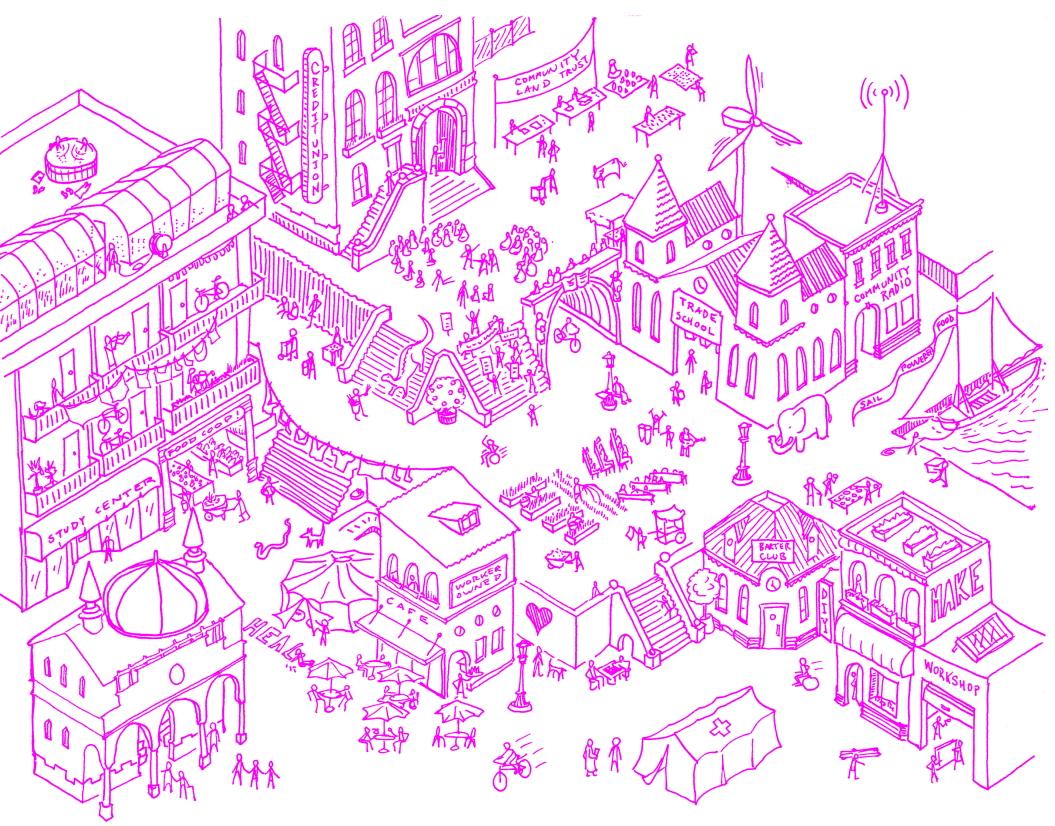
Header image by Jeff Warren and Caroline Woolard. CC BY-SA 3.0
- 1
See Flávio Dos Santos Gomes and João José Reis, eds., Freedom by a Thread: The History of Quilombos in Brazil, Diasporic African Press, 2016, and the entry by Maristella Svampa, The Latin American Critique of Development, in Pluriverse: A Post-Development Dictionary, Tulika Books, 2019.
- 2
Workers: An Archaeology of the Industrial Age. Taschen, 1993. Migrations: Humanity in Transition. Aperture, 2000.
- 3
Anwar Shaikh, Capitalism: Competition, Conflict, Crises. Chapter 16. Oxford, 2016.
- 4
Cooperatives were widely promoted by British colonial powers (Ceylon, Rhodesia), then by the governments of newly liberated nations (Kenya, Tanzania), and more recently by governments seeking to offload social service provision (UK, Italy). – MN
- 5
See Chapter 2, The Road of the Poor and the Popular Economy, in Solidarity Economy Roads. GEO.Coop, 2019. https://geo.coop/story/solidarity-economy-roads-chapter-2 – MN
Citations
Luis Razeto Migliaro, Matt Noyes (2026). Cooperative Enterprise and Market Economy: Chapter 17. Grassroots Economic Organizing (GEO). https://geo.coop/articles/cooperative-enterprise-and-market-economy-chapter-17
Add new comment