
Introduction & Preface | Chapter 1 | Chapter 2 | Chapter 3 | Chapter 4 | Chapter 5 | Chapter 6 | Chapter 7 | Chapter 8 | Chapter 9 | Chapter 10 | Chapter 11 | Chapter 12
Translator’s note:
What is the difference between “cooperative integration,” “intercooperation,” and “cooperation among cooperatives?”
“Intercooperation” and “cooperation among cooperatives” (the latter being the term used in ICA Principle 6), might suggest a relation that is somewhat arms length, perhaps buying each other’s products, joining in alliances, or supporting shared legislative goals, but maintaining operational independence.
“Integration,” on the other hand, suggests a denser interweaving of organizations, something like Mondragon’s industrial groups, in which member cooperatives, while retaining their autonomy, commit to profit-sharing and other solidarity practices among cooperatives, or, the even more ambitious Lagun Aro cooperative social insurance program that famously provided unemployment benefits, re-training, and job placement for members of Fagor Electrodomesticas when it failed.1
For Razeto, it is not the term used that matters; it is the distinction between the basic objectives of cooperative integration – representation and operations.2 Representation is about advancing the interests and aspirations of labor and community in civil and political society. Operations refers to the economic and technical gains to be achieved through greater cooperation in production, distribution, consumption, research, etc. While the economic and operational functions are the foundation for a cooperative movement, it is through efforts to gain social, cultural, and political representation that cooperativism emerges as a social force.
The cooperative movement focuses on building solidarity economy here and now as an autonomous social, economic, cultural, and political system. This makes it different from traditional social movements centered on pressuring the powers that be to meet their demands or needs. So are existing modes of integrated cooperative representation typically modeled on labor unions and similar civil society organizations, a model that does not align well with the goals and practices of cooperativism?
The new approach that Razeto proposes here is made up not through federation of cooperative businesses but association of individuals in small groups or base communities.3 This is his movement-building perspective: cooperative organizing from the grassroots, with a clear distinction drawn between representational and operational functions. In the next chapter, he will explore the second function, economic and operational integration, proposing an “intercooperative market of productive factors.”
- Matt Noyes
Chapter 13
Cooperative Integration for Movement Building
1. - The integration of cooperative enterprises in organizations and associations that unify and coordinate their economic, social, and cultural activities, is considered a necessary feature of cooperativism, boosting its social presence and economic efficiency. Cooperative integration is also one of the principal conditions for the fulfillment of the goal of social transformation. There is a very broad consensus among scholars and organizers of cooperativism that such intercooperation enables individual cooperatives, especially the smaller ones, to overcome a series of limitations that they confront when operating in the market and take maximum advantage of the possibilities the market presents.
Cooperation starts from the principle that through association, individuals can realize better results in those activities that alone would require great effort with less chance of success. It would follow that the broader range of action that can be obtained through cooperation among distinct cooperatives can only expand the operational possibilities of each one. In fact in every country where the cooperative movement has reached a certain degree of development, it has given rise to processes of integration, through the building of second and third level cooperatives, and through the constitution of representative associations (federations, confederations, etc.).
Nonetheless, we have seen, and it is generally recognized, that the necessary levels of unity are rarely reached and that various problems and difficulties impede the process of integration, limiting its practical impact.
For example, ideological differences and differences in strategic orientation between branches of the cooperative movement which are organized around particular economic, social, political and religious conceptions, sometimes give rise to distrust, fear of unfairness, power struggles, and other conflicts.
Another obstacle to integration derives from a tendency to embrace intercooperation for reasons that are too abstract and general. It is held that the power and efficiency of the cooperative organization will be greater, the greater the degree of association between cooperatives, and as a result integration may be promoted even in the absence of a real need or an economic or technical justification. Cooperatives may end up associating even though they are of different sizes, do not share similar productive or economic frameworks, lack a common geographic location, and operate in different markets. Such conditions inevitably provoke resistance to integration and undermine its credibility.
A similar reaction occurs when integration is carried out in a such a way that it gives rise to bureaucracy and the concentration of decision-making power in vertical structures, or when the interests of a member cooperative are not aligned with those of the parent organization with which it is affiliated.
Of course, integration always implies a certain delegation of functions and thus a partial loss of autonomy for each cooperative; at the same time, it is normal that different cooperatives operating in the same market might find themselves in competition. Because integration implies planning or programming the activities and operations of distinct enterprises, it can lead some of them to feel disadvantaged or excessively constrained by a parent body.
The existence of these and other problems does not lead us to conclude that cooperative integration is unnecessary or inappropriate, but rather to go beyond the simple general affirmation of the associationist principal, considering the problems in their specificity, and identifying new forms and mechanisms that have arisen in practice.
It is for this reason that we critically consider the distinct objectives and different modes of integration, and the usual processes and mechanisms employed.
2. - In Cooperation and Cooperativism the authors distinguish two fundamental objectives of integration: representation of the cooperative movement so as to defend and promote its interests in the legislative arena and among public and private organizations, and operational efficiency of cooperatives in the market.4 The first objective is normally achieved through the creation of representative bodies such as federations and confederations, while the second gives rise to the association of enterprises (vertical or horizontal), to intercooperative agreements, or the creation of second or third tier cooperatives. Walter Summerhoff, for his part, identifies four principal functions of integration:
a) unity of doctrine and promotion
b) rationalization of administrative and operational functions
c) strengthening of market position, and
d) representation.5
Cooperative practice in most countries shows that while it is normal for cooperatives to create organizations of various types and at different levels in order to accomplish particular objectives and functions, there is also a tendency for these organizations to take on a wide array of functions: doctrinal orientation, education, social representation, production planning, coordination of supply, marketing, information exchange, administrative streamlining, etc. This phenomenon underscores the fact that cooperativism is simultaneously an economic, social, and cultural phenomenon with political implications. And yet, it can cause confusion, as much ideological as operational, with negative effects on the efficiency of affiliated enterprises, because the specific logic of the economic, socio-political, and cultural processes is not homogeneous among cooperatives. They have different behaviors, rhythms, and tempos.
Observation of these facts leads to a first general point with reference to the forms we can use to build processes of integration, overcoming some of the difficulties that have arisen in practice: we must clearly distinguish between the two types of integration: integration for the purpose of representation, and integration in pursuit of operational objectives. They are parallel, but separate, organizational processes, even if they ultimately converge in a perspective of building a coherent and unified economic sector and social movement.
Let us begin with the problem of integration for purposes of representation. (We treat integration for operational objectives in Chapter 14.)
Integration for the purpose of social representation has been the motivation for the formation of a number of organizations of different types, at different levels, together constituting that which we can call a cooperative movement. Normally these organizations are built on a shared geographic base: local, regional, national, or international. They may also be built by cooperatives of the same type (consumer, credit, production) or those operating in a similar sector of the economy and area of production (housing, agricultural, mining, craft, manufacture, etc.).
The existence of these different bases for integration (geographic location, cooperative type, economic sector) has led to debate about which criterion should have priority. But, these lines of organization are equally necessary, since cooperatives encounter actors in each with whom they share common interests. At the same time, there are also instances of higher level organization that unify the movement and represent it.
The principal problem to address, however, has to do with concrete questions related to the form of movement organization.
In modern societies we have experience with various models of representative organization; two of the most widespread in the popular sectors and social movements are labor unions and political parties. There are other, more general, forms of organization for popular representation – the parliamentary model of political representation or ecclesiastical models of participation in religious life – but those are not of interest to us here, given that their specific characteristics remove them too far from the problems of cooperative integration.
When it comes to integrated cooperative representation, the higher level organizations of the cooperative movement have generally tended to adopt the formal model of labor unions. Of course, there is no single model of organization in labor unions, but it is possible to identify a fundamental organizational matrix: local unions affiliate with provincial or state federations according to their branch of production or economic sector, the latter affiliate with national federations or confederations, and ultimately in national labor organizations that unite the different sectors. These national organizations can, for their part, be organized regionally or by province or state to deal with local problems and issues that affect unions of various types. Local unions typically participate in higher level organizations through elected representatives or delegates, while the leadership bodies of the federations, confederations, and national organizations can be elected directly by locals or through indirect representation involving proportional representation on the level of union delegates or representatives.6
Applied to cooperativism, this organizational structure has given rise to a complex movement organized geographically, and by cooperative type or economic sector, with federations, confederations, and centers in each country. It is this organizational system that has confronted the problems and difficulties we mentioned earlier.
Just as the elementary unit of union federation is the local union, individual cooperatives are integrated into cooperative federations and confederations. Decisions adopted in the higher level organizations connect and commit the affiliated enterprises, which participate in the higher decision-making instances through delegates or representatives.
There is a certain inevitable loss of autonomy of the member cooperatives in this arrangement, since they delegate to the organizations in which they participate areas of decision-making often involving economic, administrative, juridical and even general operational matters.
It is not surprising that, from the moment at which the higher level organizations concentrate decision-making power with respect to member cooperatives, even as they face different agents and institutions external to the movement (the state, other enterprises, unions, the market, etc.), and notwithstanding the good will and dedication to the cooperative cause of their leaders, we see bureaucracy, power struggles, ideological disputes, attempts to use the organizations for political goals, etc. These developments become obstacles to the integration of the cooperative movement.
Perhaps the main reason that an organizational model that works well, more or less, in the field of unionism might not be equally effective when applied to cooperative organization, is that there are big differences between one and the other type of organization and movement. Unions are normally conceived of organizations of wage workers pursuing the defense and promotion of workers’ interests against employers, who have opposing interests. As a result, unions are organizations for bargaining and conflict, organizations of demands and social struggle, for which the degree of power and pressure that unions can concentrate and mobilize jointly in decisive moments in industrial and social conflicts is critical.
Cooperatives, too, are workers organizations that aim to promote the interests of economic groups and categories that are currently subordinated, especially workers and communities. But the activity they develop is radically different from that of unions, since cooperatives focus on organizing labor and community autonomously in order to find direct solutions to the problems they face, standing on their own forces of association and construction, rather than placing pressure on an opponent, public or private. In the same way, cooperativism’s objectives of economic and social transformation are to be achieved not through social pressure and force applied to others but through their own economic and organizational activity, from the effect of diffusion and influence that flows from their harmonious functioning, from efficiencies and benefits for members, and from education in and popularization of their principles and methods of work.
Clearly, this form of projecting, organizing, and carrying out action requires a different model of integrated representation from that which has consolidated itself in union movements. Imitation or adoption of forms that have matured in other types of social and popular movements has historically constituted a limit on the cooperative movement’s development and autonomy.
An effort of innovative and creative elaboration of new forms is also needed because other practices of representational organization that we have experienced in various fields, – especially in politics, with its system of parties and parliaments – also seem ill-suited to our needs. As we have noted in passing, in a previous chapter, standard forms of political organization, in addition to combining instances of representation with bureaucratic mechanisms, typically imply a high degree of concentration of decision-making power and tendencies to separate leaders from followers, as well as sharp ideological conflicts.
The principles, aspirations, and possibilities of cooperation point toward innovation. For cooperativism, thinking these problems through in original ways and on autonomous terms remains, then, an objective or task to be accomplished.
As a simple proposal for debate we offer below an organizational model of a new type for an autonomous movement of cooperative integration. The proposal is based on a strict separation between integration for the purpose of representation, diffusion, promotion, and cooperative education, on the one hand, and integration with economic and operational purposes, on the other, which we will analyze in the next chapter.
What objective is it possible and appropriate to set for oneself at this level? To speak of “integration for purposes of representation” seems to be too narrow, insufficient for understanding the economic experiences of which we are speaking. Of course, “integration” – in the sense of articulation, coordination, association, unification – and “representation” – in the sense of asserting the aspirations, concerns, interests and rights of cooperativism vis-a-vis relevant institutions and bodies, in politics as well as civil society – are fundamental elements of a social movement based on the various forms of cooperation that we are considering. But, if we take into account the multiplicity of motivations and experiences that make them up, and, above all, the multifaceted and polyvalent character of cooperativism, which is as much economic as social, political, and cultural, the necessity arises for a broader formulation of the ends and objectives that a cooperative movement and the members it integrates surely wish to propose.
3. – Towards a project of cooperative integration
What the “movement” has to formulate is a long term project that is very broad, capable of involving in its practice the multiplicity of subjects who make up what we have called the “cooperative phenomenon,” around which to unite the consciousness, will, and action of those who come to share or adhere to one of its essential aspects or dimensions.
Certainly, this is not the time or place to flesh out the contents of such a project, although many of the orientations and lines of that project can be found in, or derived from, the different themes analyzed in this book. Defining the project is an open and permanently renewed task for its protagonists: the different types of subjects involved in or committed to its realization. In any case, and by way of suggestion, we can signal some processes that appear to us to be essential for the project, namely:
a) The promotion and fomenting of new cooperative economic units with various configurations, and in greater numbers. This implies in particular the development of organizing and business administrative capacities on the part of workers and communities, as well as the motivation of the subjects who possess the necessary factors and are disposed to “invest” them and make them grow in enterprises created by Labor and Community.
b) The development of existing cooperatives and of the cooperative phenomenon as such, and enhancements in their efficiency. We do not refer here to the immediate and particular operations of each enterprise in the market; their own organizers and directors are responsible for their efficiency in that regard. We are speaking more broadly about the progress which flows from organizational coherence and the application of criteria and norms based on the specific rationalities and logics of Labor and Community as organizing categories, the diffusion of which depends to an important extent on the principles and criteria that are promoted by intercooperative bodies.
c) It is essential, too, that the economic units of the cooperative sector find each other and become related, articulated, organized and associated, as a function of their own needs and benefits. While we have seen the value of the organic separation of integration for representation from integration for operations, the movement needs to ensure that this functional and operational articulation be realized and that it achieve its purposes. It is a question of creating enabling conditions and not of applying undue pressure, because the decision to participate in operational integration is to be made by the people involved themselves. They are the ones who should analyze the opportunity and weigh its costs and benefits.
d) The creation of a system of promotion and support in which the economic units and their instances of integration collaborate in order to confront the many problems, difficulties, and challenges they face, spreading and facilitating integration by means of research, education, skills-building, and extension, as well as different specialized services.
e) The deployment of a global system that is at once cultural, social, ideological, and political, fostering a culture of solidarity and a social and political environment that supports labor and communities in their search for autonomy and economic protagonism, and that, more generally, lays the foundations for the advance of cooperativism as a global project.
If this is how we understand the project of integration for purposes of representation, and the objectives it pursues, it is obvious that the movement which embraces and advances them has to transcend the limits of the cooperative movement as it has existed to this point.
We have seen that cooperatives, with all of their existing instances of integration, are just one piece of a very broad and pluralistic process of development of alternative forms of enterprise and of the search for a popular solidarity economy centered on labor and community. The project of developing this economic alternative, on the other hand, should arise our of a process in which civil society becomes conscious of the problems and crises that characterize contemporary civilization and its economic structures, and it should inspire the commitment of many subjects and actors who experience or see the need for an alternative.
We now hope to imagine the form of organization that a movement with such ends might assume. A first question to resolve is whether the base participants of the movement would be people or enterprises. There are reasons why it is inadvisable to make enterprises the basis of a movement like this. On the one hand, it does not seem to align sufficiently with their specific objectives; on the other, the differentiation of rubrics, scales, and logics that we find in enterprises in the sector leads us to foresee organizational complexities that might end up dissipating the power and even the motivation required by the movement.
One factor that must be taken into account when we pose the problem, which is decisive if we hope to sustain the need for a separation between the goals of integrated cooperative representation and the mechanisms of intercooperative economic operations, is the criterion of proportional management based on the effective participation of each member in the ownership of the enterprise. This criterion, which we have proposed with respect to the functioning of solidarity enterprises as such, implies that the members have a differentiated participation in economic management, which will tend to be extended also to the level of integrated cooperative economic operations. However, this type of differentiated participation is not justified when it comes to integrated cooperative representation and social and cultural action. Every member of the cooperative movement at this level should find themselves in a situation of strict equality, with identical capacity for opinion, decision, and vote.
If the base participants of the movement are enterprises, as such, differences in internal leadership structures in each enterprise would be reflected in intercooperative bodies, as would the different economic conditions of its various constitutive enterprises. For this reason, the cooperative movement should be made up of individual persons, and not enterprises.
The elemental bodies for participation of members in the cooperative movement could be groups or base communities, whose seat or center of formation would be the cooperatives, without reducing the groups to those units. One could imagine enterprises in which one or more such groups or communities could be formed, depending on the number of members and their degree of interest and participation. In an enterprise with many members, the base community could be too large, which would make it harder for members to have deep, constant, personal, and effective participation.
On the other hand, it seems useful to define a principle of voluntary and open membership, such that the movement be constituted by those people who have real interest and ability to participate in its objectives and activities, and to prevent a situation in which a formally large movement is marked by limited real activity of members, with all the problems of representativeness of the organization that this implies.7
Membership in a base community, and through it the cooperative movement as a whole, would normally imply the payment of periodic dues on the part of those individuals who voluntarily join; but one can also imagine a situation in which cooperatives as such contribute some specified proportional amount to help finance the movement, since the activities and functions of representation, promotion, education, and diffusion carried out by the movement would benefit the enterprises and the cooperative sector as a whole.
The base communities, of course, would not have to remain isolated, but could establish a network in which different communities could interact, connected and integrated through various types of links.
On the one hand, there would be flows of information and communication. Each group would be both an transmitter of information (of whatever type of information that its members wish to communicate to others: ideas, intellectual elaborations, items of interest, suggestions, proposals for action, etc.) and a receiver of all the information put out by the other groups. Each group or base community would operate as a creative center capable of autonomously generating ideas and taking initiative, finding in similar groups the counterparts, allies, and interlocutors they need. Information and initiative should be freely communicated, with each group or receiving community free to decide whether to accept, embrace, or respond to it.
In order for the information to flow, it is indispensable to organize a communications center whose principal function is intermediation, receiving information from each group and efficiently transmitting it to all the others, using the appropriate media.
As a system of information and reciprocal communications, the network would be completely horizontal, without hierarchical structures. The technical communications center does not have to have any management role nor should it be granted decision-making powers by the groups or base communities to which it is accountable.
Nonetheless, the network could have a second category of links that connect the participating groups, giving rise to an extensive organization that integrates the movement for purposes of representation and the organization of gatherings, assemblies and other events that bring together some or all of the constituent groups. Thus, a grassroots groups could be linked up through sectoral councils, based on a shared geographical location or a similar type of cooperative or economic activity.
Taking into account both criteria, the same grassroots group could belong both to a local council and to a sectoral (or industrial) council. These sectoral councils could be made up of representatives or delegates from the base communities, establishing in this way a permanent connection between the higher level bodies and the base organizations of the movements, and also serving as a basis for a general assembly of the members of all the groups, which would be called periodically or on special occasions.
Using the same approach, the movement could generate higher level organizations, up to a center for coordination at a national level. This last body could provide a series of technical services for the tasks of education, information, juridical and economic guidance, etc. Similar technical commissions would probably also be formed in the lower level bodies, including in the base communities; as long as they operate as support services, providing consultation, without direct decision-making power, these would not give rise to phenomena of bureaucracy or technocratic rule.
What we have proposed is just an imagined organizational schema, a working hypothesis that points to ways to overcome some of the difficulties that occur when processes of cooperative integration reproduce the traditional scheme of labor union organizations. Beyond the organizational proposal itself, what seems decisive is the affirmation of the criterion of separation of projects of integrated cooperative representation from the structures of economic and operational intercooperation. This criterion, in effect, not only favors the formation of an integrated cooperative force that promotes and defends the fundamental ideas and interests of cooperation in relation to public and private institutions, but also permits a process of cultural development and diversification, and the constitution of a social power that will not interfere in the economic functioning or enterprises that need to act in the market with autonomy, flexibility, and an entrepreneurial spirit, but rather make itself present through personal and community action.
Translated by Matt Noyes
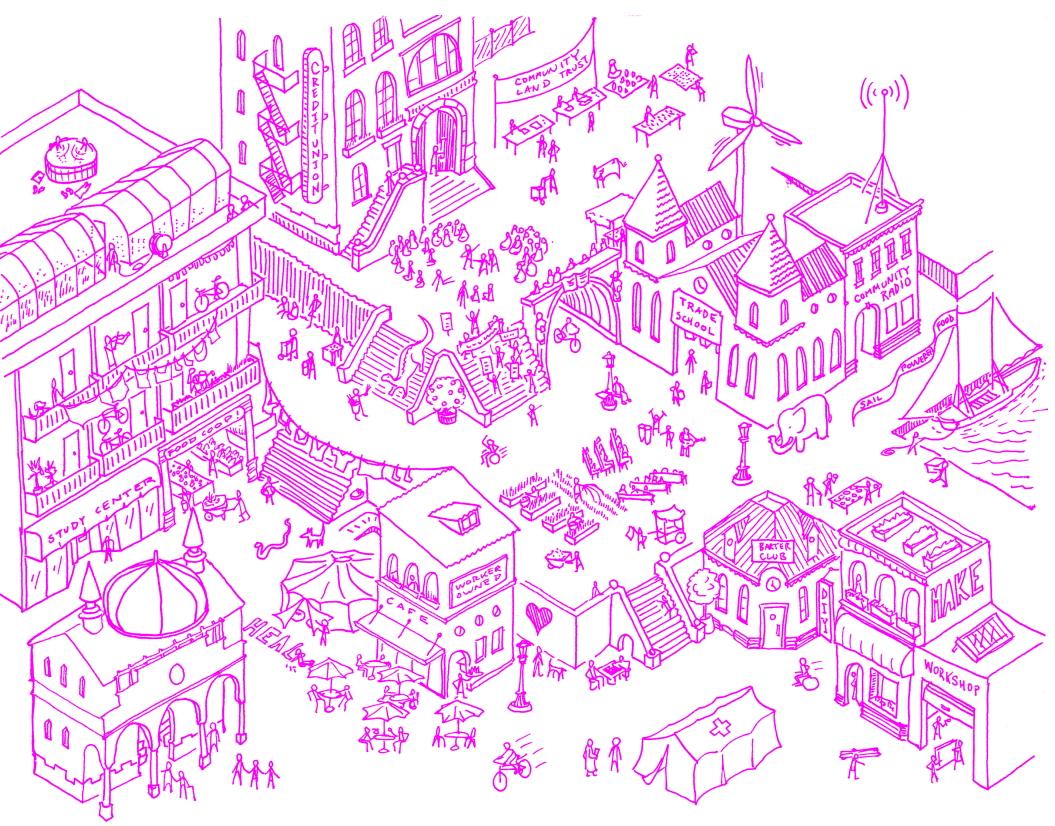
Header image by Jeff Warren and Caroline Woolard. CC BY-SA 3.0
- 1
For a critical analysis of Mondragon’s job security system, see Basterretxea and Santos-Larrazabal, 2021, Intercooperation, flexicurity and their impact on workers: The case of Fagor Electrodomésticos. https://onlinelibrary.wiley.com/doi/full/10.1111/apce.12329
- 2
For a typical example of how the terms are used interchangeably; see, for example, https://www.aciamericas.coop/wp-content/uploads/2023/06/Integracio%CC%81n-y-cooperacio%CC%81n-entre-cooperativas.pdf
- 3
The latter term is no doubt an allusion to the Christian Base Communities that were key organizing units of social movements across the global south, inspired by liberation theology.
- 4
This appears to be a reference to Araya, R., Ayala, H., & Benecke, D. (1980). Cooperación y Cooperativismo. Santiago de Chile: Ediciones Nueva Universidad. - MN
- 5
Walter Sommerhoff was a founder of the construction cooperative SODIMAC and author of several books and articles on cooperativism, including Desarrollo integral en dignidad: lecciones de una experiencia cooperativa, 1980, Intercoop, and La Trascendencia Del Cooperativismo Para Chile, Revista de Trabajo Social, n° 15, 1975, pp. 27-34 MN
- 6
There are also international federations, of course, and, at every level, there can be rival union groups, often distinguished by their political affiliation or ideology. – MN
- 7
Razeto’s term is “libre asociacion,” but the relationship he describes seems better captured by the terms of the first ICA cooperative principle, which I use here. – MN
Citations
Luis Razeto Migliaro, Matt Noyes (2025). Cooperative Enterprise and Market Economy: Chapter 13. Grassroots Economic Organizing (GEO). https://geo.coop/articles/cooperative-enterprise-and-market-economy-chapter-13
Add new comment