
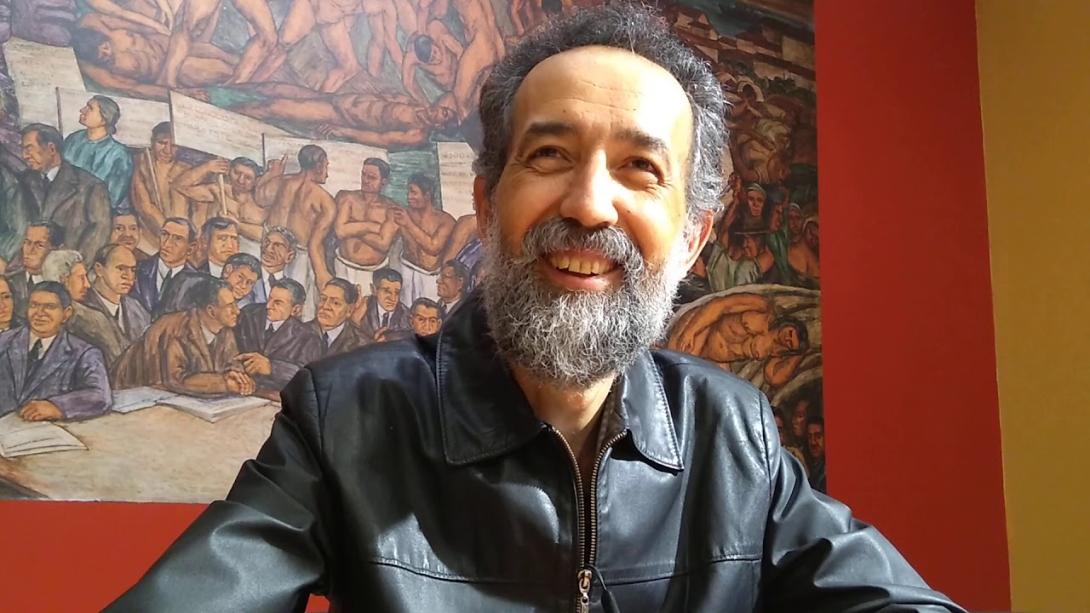
Summary and commentary on Solidarity Economic Circuits and Economic Liberation – moving from capitalist economy to liberation economy, by Euclides Andre Mance. Translated from Spanish to English by Mike Calvert and Euclides Mance. (Solidarius, Curitiba 2022)
Introduction
The purpose of this article is to share the concept of a Solidarity Economic Circuit as presented in Euclides Andre Mance’s 2022 curriculum Solidarity Economic Circuits and Economic Liberation – moving from capitalist economy to liberation economy (Solidarius, Curitiba 2022) and consider how it might be applied in practice in a North American context. I’m looking at this from a practitioner’s standpoint, as someone active in local food system organizing: I pick up and deliver food for the food rescue program of a local non-profit; help organize a cooperative Farm and Art Market; do field work as a member of a new farm worker cooperative; help operate a local buying club; and coordinate a working group on commons ownership of local farm land as a co-op developer for the Rocky Mountain Farmers Union.
I learned about Euclides Mance’s work a few years ago, from his 1999 book A Revolução das Redes (The Network Revolution) and from an interview I did with him for GEO.Coop.1 I was impressed by his broad scope of concern – from liberation philosophy to platform cooperativism and solidarity economy on a global scale – and his very practical engagement in developing grassroots organizing capacity and infrastructure. One practical approach stood out: the creation of local buying clubs as an initial step in community economic self-organization. This approach seemed modest and feasible, but also strategically audacious. By gathering in our communities to purchase together the things we need, using money we already have, we can simultaneously meet our needs and build personal and collective capacity and infrastructure for cooperation and self-management. Not only did this seem like an obvious first step for people interested in organizing a food cooperative or food hub, but it linked that to something much more ambitious and promising: a self-organizing network of cooperative enterprises and commons that meets a widening variety of needs and progressively replaces conventional, capitalist economic circuits with an alternative system incorporating monetary and non-monetary exchanges, donations, gifts, etc.
Solidarity Economic Circuits also seem to offer a robust vehicle for inter-cooperation, locally, regionally, nationally and transnationally. Central to this model, developed by Mance and others, is the use of an online platform, Solidarius.net, in which distributed ledger technology – aka blockchain – is used to manage credits and transactions. Like others, I have been critical of the promotion of blockchain solutions (the boom before AI), but this might be a good use-case for the technology. In any case, it is not required for entry into this type of organizing and I will not discuss it here.
Thank you to Euclides Andre Mance for patiently responding to repeated questions.
The text that follows is my summary and interpretation of Mance’s ideas, as presented in Chapter 9 of a curriculum he has been using with groups throughout Latin America and the Carrribean.2 Quotations from that text are followed by the corresponding chapter and section numbers. Any errors are my own.
What is a Solidarity Economic Circuit?
In a capitalist economy, money and commodities circulate in a process centered on the accumulation of capital. The idea of Solidarity Economy is to create an alternative economic process, in which flows of values are centered on solidarity.3 The Solidarity Economic Circuit (SEC) is such an alternative: as a networked community-based cooperative economic organization that aims to do four things:
- provide the means required for people's “bem-viver” (good-living) by connecting consumption, interchange, production and credit;1
- liberate the economic forces of production, interchange and credit in order to provide everyone with the means necessary for the realization of public and personal freedoms, which are exercised in an ethical way;
- realize the principle of "from each according to his or her capacity and to each according to his or her needs, for the ‘bem-viver’… of all";
- organize other modes of production, other systems of interchange and credit, and other social formations, of a post-capitalist character, centered on community self-management and popular power (people power). (9.0)
The smallest unit in the network, which is also the starting point for organizing, is something like a cooperative buying club. People in a given community join together to purchase or otherwise obtain the goods or services necessary to meet their material needs. While goods and services can be obtained through donation or barter, to begin with, monetary exchanges play a key role. (One goal of the Solidarity Economic Circuit is to progressively shift from monetary to non-monetary economic circuits.)
In a buying club, members of the club use the money they are already spending individually to make the same purchases collectively. This has several advantages: buying in bulk is often cheaper than buying in small quantities; buyers can share knowledge and information as to product safety and quality; they can prioritize local producers, growers, and service providers; and they can influence the practices of suppliers, for example by refusing single-use plastic and insisting on reusable packaging.
The operations of the buying club are carried out by members themselves, choosing products to list, placing orders, arranging deliveries, and doing the distribution and administrative work together, with some form of distribution of labor. In the process of organizing a buying club, participants develop the skills and build the culture needed to create a cooperative alternative to the dominant capitalist culture and economic models. Above all, they learn to operate democratically and in a spirit of solidarity.
As the buying club grows, members may decide to create paid positions to help do the work, creating jobs for community members. This requires the collection of fees in addition to the money members pay to buy their items. In a typical buying club, the goal is not to accumulate finances, but to meet member needs. In a Solidarity Economic Circuit, the fees collected, which are set and controlled by the members themselves, are also used to support the creation of new buying clubs, expanding the network and increasing its bargaining power. The SEC creates an “economic liberation fund” which can be used to expand the network and to fund other types of cooperative projects, for example a community childcare center or a print shop.
In the SEC model, the local buying club does not operate in isolation. The idea is to link up with other buying clubs and cooperatives, seeking out suppliers that are cooperatively organized and supporting the emergence of new cooperative suppliers. Buying clubs can join together to make purchases or to invest in shared resources or infrastructure. It is this intensive cooperation among cooperatives that makes the individual buying club not just an enterprise but a node in a Solidarity Economic Circuit.
How to organize a Solidarity Economic Circuit?
As in any cooperative organizing, the most important step comes before the process begins, and is never complete: forming a local organizing group characterized by a high degree of trust and solidarity. The group can be small, but the cultivation of solidarity is critical. This solidarity and trust must be constantly regenerated, through education and dialogue.5
The first step for the group is the mapping and diagnosis of the participants’ needs, the ways they “appropriate” or make use of goods or services, and the way they obtain the things they need.
As Mance points out, people have relational needs as well as material needs. Relational needs are emotional and cognitive, things like “affection, love, friendship, respect, listening, care, etc.” Relational needs have to do with the human dignity we find in our relationships with others, relationships of “ethical proximity.” (9.1.1)
We meet our material needs with products, goods and services, including those that are donated or naturally available, those we share with others, and those that take the form of commodities. These needs, too, are very much social, being necessary to human dignity and quality of life, the “bem-viver” of each person and the community. For this reason their quantity, quality and regular availability are crucial. (9.1.1)
The Solidarity Economic Circuit is focused on provisioning material needs, but it would be very interesting to map people’s relational needs as well, and analyze how they are met together with or separately from the material needs. One cooperative organizing project in which I am involved, for example, got its start in a community potluck dinner that met relational as well as material needs.
Moreover, as Luis Razeto has explained, the “C Factor” (solidarity in its various forms: care, collaboration, compassion, cooperation, communication, trust…) is not just personal or subjective phenomenon, it is a factor of production. In solidarity enterprises, it is the organizing factor around which the other factors (labor, finance, technology, management, land) are centered. The development and regeneration of C Factor is vital for the success of this type of economic project and for the satisfaction and evolution of relational and material needs.6
It starts with a catalogue of needs
In Mance’s model, participants create a catalogue of their needs and the goods and services needed to satisfy them, (in Mance’s lexicon, “satisfiers”). The satisfiers are then “grouped according to the mode of their appropriation for use or consumption.” (9.1.2) There are three modes of appropriation: personal, associative, and public.
Personal appropriation refers to personal consumption or use, for example of “food, beverages, medicines, hygiene products, clothes and other things that people need to consume exclusively and individually every day or relatively frequently.” (9.1.2)
Associative or shared appropriation is related to “goods and services that people use in a shared way, such as the resources of a household (table, stove, refrigerator, etc.) or those used by collective entities, such as a club (sports fields, dance floor, swimming pool, etc.).” (9.1.2)
Public appropriation is related to “freely-appropriated public goods, such as streets, squares, parks, kindergartens, schools and a series of other equipment and services” that can be provided by the state or non-state institutions. (9.1.2)
The next step is to group the satisfiers according to how they are to be obtained. We can refer to these as modes of provisioning. (Mance calls them modes of obtaining, but I think “provisioning” better suggests the protagonism of both producers and consumers.)
Mapping the modes of provisioning
There are three main ways in which we obtain the goods and services we need: purchase, non-monetary reciprocal exchange, and donation or gifting.
As Mance points out, purchasing does not have to involve “the capitalist market, organised for profit, where goods are offered in short supply and with a shorter and shorter lifespan.” It can also take the form of “a collaborative network of solidarity suppliers, who produce and distribute goods in abundance and with a longer lifespan, to meet the needs of all, at fair prices…” (9.1.3) A typical buying club is focused on this, monetary, mode of provisioning. As noted above, a long term goal of SEC is to expand the sphere of solidarity provisioning and reduce dependence on the capitalist market.
People can obtain many of the things they need either directly – e.g. in a one-to-one exchange – or indirectly, through a kind of credit system with other participants in the circuit. This can be more of less formal and organized, taking the form of barter, time banking, offers/needs exchanges, local currencies, etc..
Finally, people often meet some of their needs and the needs of others through donations and gifts. For example, through mutual aid activities or food banks. In the Solidarity Economic Circuit, there are items that people may “freely appropriate according to their needs... and according to the availability of the products offered for donation.” Instead of paying in cash or some form of non-monetary exchange, participants are free to receive what they need while “honouring reciprocity in donation, giving back to third parties in the circuit what it is possible for them to offer for free.” (9.1.3)
Drawing up consumption and supply plans
Once the needs, satisfiers, modes of appropriation and provisioning have been documented, the next step is to create two plans. The consumption plan, is a list of the good and services needed by each participant (individual or a family or household unit), classified by the type of appropriation and the mode of provisioning. Mance points out that this list is “only a reference to possible acquisition in the Circuit and not a commitment to acquire the goods and services” on it. (9.2)
Alongside the consumption plan, a supply plan is created, listing the suppliers who can provide the goods and services needed. (The circuit is not made up of consumers alone. It includes both consumers and suppliers or producers. Some participants join the circuit to meet their needs but also to provide skills and products to others.) Because some needs can not yet be met by the providers in the circuit, known as “solidarity suppliers,” it is necessary to include external suppliers in the supply map as well.
Based on the Consumption Plans and Supply Plans, electronic or physical catalogues are assembled to meet everyone's needs, preserving the freedom of each person to decide what they wish to consume, what they wish to offer with their personal work or that of their cooperative or self-managed enterprise, and the mode of provisioning and appropriation chosen. (9.3)
As we have seen, in a Solidarity Economic Circuit, there are three forms of exchange: buying and selling with money, non-monetary exchange using credits, and giving and receiving (donation). For each there is a corresponding catalogue of goods and services that shows how the goods and services will be consumed or used: individually, in small units, or socially. Because the plan includes offers as well as needs, it includes “all the goods and services that individuals and legal entities associated with the Circuit can offer as suppliers to meet the needs presented in the Consumption Plans.” (9.4)
The Emporium
In a buying club, members may pay in advance, pooling their funds, or when they pick up the items they ordered. It is important that the buying club maintain sufficient funds to pay the suppliers and cover other expenses of operation. Volunteer, or partly remunerated, labor and resources provided on a usufruct basis (i.e. with the individual retaining ownership of the resource but making it available for use) are often important for buying club operations. Typically, the available products are listed on a software platform that provides for online shops, hubs, and markets, but a simple spreadsheet or list is often enough.
Solidarity Economic Circuits also rely on a shop, known as an Emporium, which may be online and/or physical and handles not just monetary transactions but also the credit/points accounts and free donation.
[Monetary exchanges involve] the following steps: people deposit money into an association account and receive credits on the platform in a money account. In fact, the money remains in the fund within the cooperative account. When a person transfers money to different accounts on the platform as payments, they are actually transferring numeric values because the money itself remains in the cooperative fund within a cooperative bank. When the Emporium needs to pay external or internal suppliers, the money in the cooperative bank is used to pay them.
Non-monetary vouchers, electronic or physical, (points, credits), are used for non-monetary interchanges in the circuit. (9.5)
The amount of money people need to deposit is based on the lists of needs and supply. Funds are collected in advance and allocated using a software platform, Solidarius.net, as are credits and points. (Again, as Mance notes, this can also be organized with simple spreadsheets, especially at a small level. One might be able to use a platform like the Open Food Network platform for a similar purpose.)
The Emporium totals the purchase orders and makes the total purchase in cash. The frequency of purchasing can be monthly, weekly, or daily, depending on what the circuit defines. The Emporium can have a structure with inventories on offer, like a mini-supermarket, or operate only on a virtual platform, making purchases on demand with home deliveries or with pick-ups at a fixed location. (9.6)
Suppliers in the network (solidarity suppliers) set the prices of their products, akin to a wholesale price. (This can be done through negotiation with consumer members of the circuit.7) A percentage or set fee is added to the supplier’s price to provide a source of income for the SEC. The resulting price offered to members in the circuit may be identical to or lower than the standard price in capitalist markets, depending on the agreements reached by the participants in the circuit. The income generated by this fee has two purposes: to cover the operational costs of the circuit (the platform, accounting, rent, transportation, logistics, receiving, labor compensation, taxes, etc.), and to create an Economic Liberation Fund or Solidarity Fund.
Solidarius.net
A Solidarity Economic Circuit requires a lot of coordination, particularly as it expands to include members in more than one country. For this purpose, Mance and others developed a software platform, Solidarius.net, that provides applications and tools for the many necessary functions. Accounts are kept on a distributed ledger or blockchain which allows for automatic non-monetary transactions.
The registration of transactions in blockchains makes it possible to organise solidarity-based economic interchange systems, in which the existence of money, as a condition for the circulation of use values, can be suppressed, abolished. Economic transactions can take place both locally, within the local circuit, and between them, regionally, nationally or internationally, within the global network of solidarity economy circuits. The freer the forces of production, interchange and credit are under the solidarity economy, the greater the volume of needs that can be satisfied through donations and barter and the smaller the amount of money proportionally required for the expanded reproduction of economic values to be freely distributed for the “bem-viver” (good-living) of all. (9.12)
While it is not necessary to use the Solidarius platform in order to create a Solidarity Economic Network, the platform has been critical to building the networks that are part of the larger strategy.
Elsewhere, Mance has described Solidarius as having three dimensions:
First, there is Solidarius.net, the platform, which has tools which can be used by any solidarity economy organization at no cost, permitting the elaboration of plans for sustainability, network diagnostics, supply and demand maps, economic interchanges, etc.
Second, there is a community of people and organizations using the platform... Some use the platform for planning and assessing the viability of initiatives, one of the platform’s most widely used functionalities. Others use the network diagnostics, connecting plans for new initiatives…
Finally, we come to Solidarius as a network of research and development initiatives, coordinating education consulting and information technology services for people, projects, networks, communities and governments, encouraging organization and consolidation of collaborative networks of solidarity economy and the creation of regional economic circuits.
In each country which is part of the network, we have a national unit which is made up of these intercooperating units and collaborates in their activities, according to their needs and capacities.8
Some of the functions provided on Solidarius.net:
(1) economic mappings of needs, offers, capacities and resources;
(2) elaboration of catalogues of purchases, barter and donations;
(3) local and international interchanges;
(4) management of purchases and monetary balances;
(5) management of barter and non-monetary vouchers (points, electronic credits) with records in blockchains;
(6) management of donations and acknowledgments with records in blockchains;
(7) management of orders and inventories;
(8) search for offers and needs;
(9) administration of the account system;
(10) fund management;
(11) internal communication; etc. (9.9)
Solidarius.net currently has 3,244 registered user accounts with 850 participants in interchange communities – either projected or actual – with $184,000.00 in transactions. (Personal communication)
Surplus and The Economic Liberation Fund
The standard flow of money through a cooperative is as follows: the Cooperative receives revenue, a portion of which goes to cover costs. The remaining surplus is divided into unallocated and allocated portions. Unallocated surplus is held by the Cooperative in the form of reserves, education funds, or solidarity funds. Allocated surplus is distributed to the members on a pro rata basis according to their participation in the cooperative (hours worked, in a worker cooperative, purchases made, in a consumer cooperative). These are commonly known as patronage distributions or patronage dividends. Allocated surplus can be placed in an individual capital account, distributed at the end of the year, or periodically throughout the year.9
In the Solidarity Economic Circuit, surplus allocation is used to facilitate and promote non-monetary exchange. Members receive their patronage distributions in the form of non-monetary credits, or points, corresponding to the monetary surplus generated through their acquisitions and deposited in the fund. Members can use their points to obtain products in the Circuit, while the money remains in the fund to be loaned out or donated.10
Note that in the SEC there is both monetary and non-monetary circulation taking place, but only monetary exchanges generate surplus. There is no fee added to exchanges made with points. The SEC pays for the monetary costs associated with its operations from the money generated by the fee charged on monetary transactions. Note that the SEC is a transitional model that incorporates monetary exchange, but progressively reduces it, as part of a process of building non-monetary circuits. One can imagine a scenario in which a network of SECs have transitioned wholly to non-monetary exchanges. In that case, costs would be covered, and an Economic Liberation Fund built – needs met, i.e. – in the form of points, or through donation.
For example: if monetary purchases total $50,000 in one month, and $40,000 is the price paid to the suppliers, then the remaining $10,000 will be used a) to cover the operational costs of the circuit and shops, and b) to build the Economic Liberation Fund.
Assuming the relevant costs to the Emporium total $8,000, the remaining $2,000 that goes to the Fund is assigned to members, on a patronage basis, in the form of 2000 points which they can use to make non-monetary purchases through the Emporium’s non-monetary exchange catalogue. Those points go to the seller, who can then use them to make non-monetary purchases, and so on. Note that the points circulate within the Emporium while the original $2,000 remains in the Fund and is available for whatever uses the members democratically choose.
If a participant or the Emporium needs to convert points into money [in order to pay a supplier], they need to submit a request to the community. If the request is approved by a majority, and the fund's money is not otherwise loaned out, then the conversion can be made. In this case, the Emporium can pay the suppliers using money from the fund, eliminating the corresponding points from the Emporium's account. (Personal communication)
It is clear that this form of surplus distribution promotes the non-monetary circulation of values. But why keep a monetary fund? The purpose of forming a Solidarity Economic Circuit is much broader and more ambitious than a conventional cooperative buying club, which seeks to satisfy the consumption needs of its members. As the SEC grows, each local circuit is linked to other circuits in the network, expanding the reach of both. Members have access to a large circle of suppliers and vice versa. At the same time, as a SEC grows, it comes to have the resources necessary to provide employment to community members and, with the growth of the Economic Liberation Fund – locally and/or in the form of a shared fund controlled by the network – it can support the expansion of of existing member enterprises, spin off new shops, provide education to help others start new circuits, and more. New types of goods and services can be added, based on the needs and offers of the communities in question.
As Mance puts it, “the main objective of the solidarity economy is to liberate economic forces.” This is done through:
1. investments that expand the magnitude of the economic forces in motion, in the form of circulating value;
2. installation of new production plants and interchange structures in the form of fixed investment;
3. supporting, in correspondence to the magnitude of productive forces that expand, the emission of non-monetary signs of value, making possible the expansion of the volume of non-monetary interchanges within and between circuits, operated with blockchains or analogue solutions;
4. expanding the volume of final products and means of production offered under the modality of donation, for free-appropriation by circuit participants. (9.8)
Unlike capitalist businesses, where the goal is the accumulation of capital, the purpose here is to grow the Solidarity Economy, providing goods and services on a cooperative, self-managed basis and reducing dependence of the capitalist market. SECs may also come to offer “certain non-state public services” e.g. healthcare and childcare.11
Running a Solidarity Economy Circuit
Management: By starting small and local, the solidarity group is able to develop the community’s capacity for collective action and self-management on a feasible scale. Even on a small scale, management of a circuit includes:
(1) management of the Economic Liberation Fund;
(2) making purchases, bartering and donations;
(3) delivery of products for appropriation and personal use;
(4) management, appropriation and shared use of non-state associative and public goods and services provided by the Economic Community. (9.10)
Governance: Self-management requires participatory democratic governance, including:
(1) Periodic Assemblies: for democratic decisions by the participants, both as consumers and as associated providers, on everything relevant to the circuit.
(2) Permanent dialogue forums: face-to-face and remote, via groups on the electronic platform, integrating participants from the economic community, as consumers and suppliers, etc., on topics of common interest.
(3) Online voting...: online consultations in which participants can vote whether they agree, disagree or question proposals and projects submitted for use of the Fund's resources. The results decide whether the proposals and projects will be realized or not.
(4) Executive Team: the distribution of competences and responsibilities follows what is established in the social contract, bylaws and regulations approved by the members. (9.10)12
Work: Like any buying club, the work of operating a Solidarity Economic Circuit includes:
(1) customer service, customer satisfaction, punctuality of deposits and deliveries of products, etc.;
(2) relations with internal and external suppliers, purchasing operations, deliveries and payments;
(3) welcoming new participants;
(4) information, education and communication with partners;
(5) updating of the database and development of the platform;
(6) logistics solutions;
(7) accounting, integrating monetary and non-monetary transactions;
(8) attention to requirements and changes in legislation to operate with purchases, barter and donations. (9.10)
Work can be done by volunteers, members who have to work a shift as a condition of membership, paid employees, or worker-members. Although the latter, which commodifies labor, is not consistent with the purposes and principles of a SEC.
Education: Mondragon founder J.M. Arizmendiarrieta famously said that while a worker cooperative could be described as a business enterprise with a large educational component, it could just as well be described as an educational project with a large business component. Because the SEC model is more ambitious than a typical buying club, the role of education is larger, as is the logistical challenge of coordinating a growing number of members, products, and interactions. People interested in creating a Solidarity Economic Circuit, should carefully study the processes and history of cooperative economic organization. There are many useful guides and resources available (for example on https://ed.coop), but the best I have found is Luis Razeto’s How to Create a Solidarity Enterprise.13
Legal Form: Given the economic logic, democratic values, and larger social mission of the Solidarity Economic Circuit, some form of cooperative business entity makes sense. As a “cooperative for community self-management” the SEC can take a variety of legal forms.
To determine which particular legal entity best enables the enterprise to accomplish its goals it is necessary to consider the business, corporate, and tax laws of the particular jurisdiction where it is organized. For example, in the U.S. state of Colorado, a multi-stakeholder Limited Cooperative Association might make sense, given that there are both producers and consumers involved and a complex system of exchanges. The Economic Liberation Fund might be best set up as a separate charitable entity, foundation, or donor advised fund. In the US, where the SEC model has not been tried, it remains to be determined how best to structure the second level network that links local SECs on a national or translational level. For Mance subsidiarity is important. The idea is not to make one big centralized corporation but to strengthen the ties among local cooperative organizations.
The legal form must allow the circuits to remain integrated in collaborative solidarity networks, so that their catalogues of purchases, barter and donations are available to serve any participant from any Community integrated in the network. If possible, the co-operative must be nationally based so that it can associate people (natural and legal) from any part of the country. Also, the co-operative must foresee that members from different regions can participate as apprentices, so that they can learn the concepts, methodologies, use of tools and practical operation of how to set up and manage a Solidarity economic circuit. It should foresee that members from the same region can use the National Cooperative’s platform and registration to operate a Local Solidarity Economy Circuit, with its Emporium and [Economic Liberation] Fund. (9.11)
Moreover, it should provide that:
(1) when local circuits are consolidated, they can [separate] (split/break away) from the national co-operative, creating a new local co-operative integrated in a network with the others;
(2) in this [separation]... there should be a legal transfer of the relevant values from the national co-operative to the local co-operative, legally assigned to its members;
(3) all the cooperatives thus created can legally continue to operate in a collaborative network together with the others at national and international level, integrated in the same Global Network of Solidarity Circuits. (9.11)
Conclusion
Solidarity Economic Circuits begin with the creation of small groups of people who pool their resources, their needs, and their offers. As they develop their capacity as individuals and as a collective to operate on a cooperative basis, handling money, coordinating reciprocal exchanges, using local credits or currencies, coordinating donations and sharing, and deciding how to use the Economic Liberation Fund, they become stronger. Use of a software platform and a distributed ledger (blockchain) may facilitate this and extend their reach, particularly on regional, national and transnational levels. The ultimate goal is not to increase the volume of monetary purchases and sales, but to build a system that enables greater use of reciprocity and donations for final consumption by individuals and organizations. Finally, the Solidarity Economic Circuit provides a way to both expand the sphere of non-monetary exchanges and generate an expanding surplus that can be used to meet community needs and liberate our productive forces. (9.12)
Is it practical?
This is a question for organizers. Solidarity Economic Circuits exist in many countries in Latin America, particularly Brazil and Mexico.14Does this approach seem relevant and feasible in your context? How might it enable you to overcome the limits of current organizing practices and structures?
The approach appeals to me for three reasons. First, it is all about community-based democratic self-organization. This is something that, in my experience, it is very difficult for typical grassroots non-profit organizations to do because of their focus on service provision and programs aiming to integrate people into existing economic structures. Non-profit structures often create exclusionary and even patronizing staff – client relations. The emphasis on building collective capacity and control by community members that is part of the SEC is well-aligned with the goal of building democratic grassroots power.
Another way in which it breaks from standard community organization practice is that it requires no outside philanthropic funding, but starts from the resources that prospective members already have and use. The money I already spend on food can be spent jointly with others, saving money and giving me more control over what I consume and how I consume it. I experience this in my Buying Club.
Finally, the Solidarity Economic Circuit approach is designed to generate a fund that its members can use to support expansion and development of new cooperative efforts. It seems like an eminently logical way to start organizing for a local food cooperative, for example. You start with the group, do the work, and build the funds needed to acquire a permanent location. I have seen something similar in action in Kanagawa, Japan, where the Fukishi Club cooperative supports the creation of worker collectives through which co-op members provide additional goods and services, create employment, weave denser social networks, and spread the cooperative economy.
This is a summary of one chapter from a larger curriculum based on a decades-long body of theoretical and practical work in multiple countries that deserves to be better known among English-speaking cooperativists.
- 1
Liberation Economist, an Interview with Euclides Mance. https://geo.coop/articles/liberation-economist-part-2
- 1
4. Coined by Mance in 1998, bem-viver (“good living”) is a concept of human well-being and development grounded in practical solidarity. It is a key element in his larger philosophical framework, influenced by the work of Enrique Dussel (Philosophy of Liberation, Orbis Books, 1985) among others. It is to be distinguished from buen vivir, a term used by Alberto Acosta, Eduardo Gudynas and others, that has multiple meanings and has been tied to a variety of indigenous terms, particularly Sumak Kawsay and Suma Qamaña, though the meaning and use of these terms is contested.See Mance, A Revolução das Redes, Annex 6 (1999) https://euclidesmance.net/docs/a-revolucao-das-redes.pdf and Adriana Rodríguez Salazar, Teoría y Práctica del Buen Vivir: Orígenes, Debates Conceptuales y Conflictos Sociales. El Caso de Ecuador. (2016) https://filosofiadelbuenvivir.com/wp-content/uploads/2016/09/Tesis-Doctoral-Buen-Vivir-Adriana-Rodr%C3%ADguez-S.pdf
- 2
See the list of books and articles on https://euclidesmance.net/wp/.
- 3
It would be interesting to compare Mance’s circuits to the value flows framework https://www.valueflo.ws/
- 5
See Chapter 1 of How to Create a Solidarity Enterprise https://geo.coop/articles/how-create-solidarity-enterprise .
- 6
See Chapter 1 of Cooperative Enterprise and Market Economy https://geo.coop/articles/cooperative-enterprise-and-market-economy-chapter-1
- 7
The Venezuelan cooperative network CECOCESOLA offers an inspiring example of a cooperative collaboratively setting prices with producers. https://cecosesola.org/wp-content/uploads/2024/12/Collective-mind.pdf
- 8
Liberation Economist, https://geo.coop/articles/liberation-economist-part-1
- 9
This is a simplified flow. See the Cooperative Finance page on the site of the University of Wisconsin Center for Cooperatives: https://uwcc.wisc.edu/resources/finance-2/cooperative-finance/
- 10
It is not clear how this system would square with legal requirements that a certain percentage of surplus must be distributed to members in cash, common in US cooperative statutes.
- 11
Social cooperatives, and highly developed cooperative networks like Mondragon and CECOSESOLA, often provide such non-state services.
- 12
There are many good educational resources for cooperative governance. See for example, Community Rules https://communityrule.info/templates/ from the Media Design Lab.
- 13
https://geo.coop/articles/how-create-solidarity-enterprise Users of the version of How to Create a Solidarity Enterprise on the GEO.Coop website should be aware that they will need to adapt it as they go to make it relevant for their particular context and audience.
- 14
See this study of SEC in Brazil, Mexico and the Dominican Republic. https://jubileusul.org.br/wp-content/uploads/2021/06/Investigacion-Deuda-y-Circuitos-Economicos-Solidarios-final2-_Version-20-Jun-21.pdf
Citations
Matt Noyes (2026). Reflections on Euclides Mance’s Solidarity Economic Circuits and Economic Liberation. Grassroots Economic Organizing (GEO). https://geo.coop/articles/reflections-euclides-mances-solidarity-economic-circuits-and-economic-liberation
Add new comment