
Strength & Struggle in Unionized Co-ops
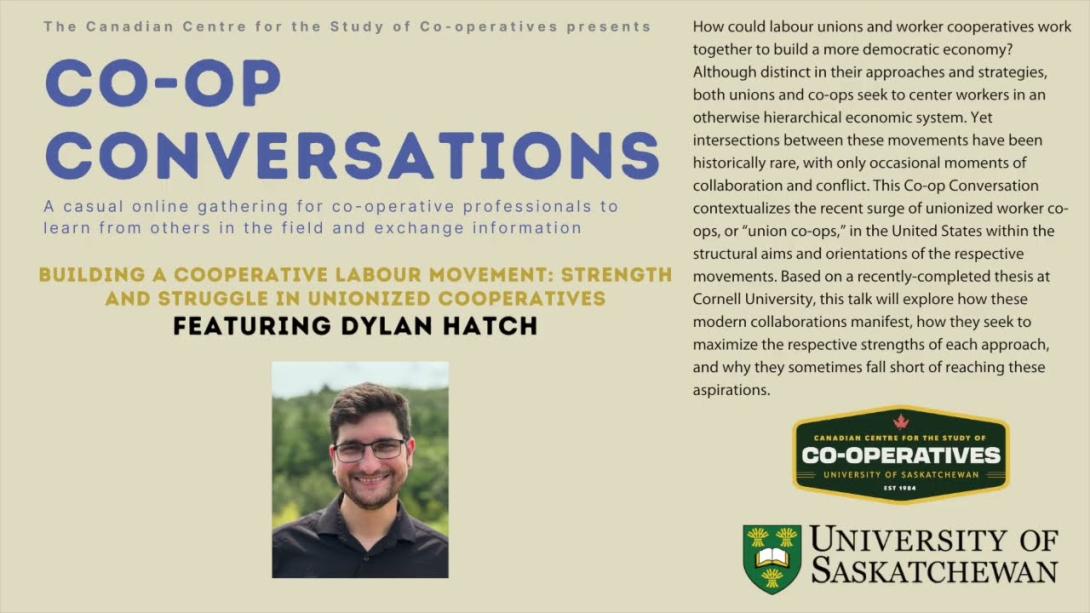
This month's Co-op Conversation featured Dylan Hatch and his talk, "Building a Cooperative Labour Movement: Strength and Struggle in Unionized Cooperatives".
How could labour unions and worker cooperatives work together to build a more democratic economy? Although distinct in their approaches and strategies, both unions and co-ops seek to center workers in an otherwise hierarchical economic system. Yet intersections between these movements have been historically rare, with only occasional moments of collaboration and conflict. This Co-op Conversation contextualizes the recent surge of unionized worker co-ops, or “union co-ops,” in the United States within the structural aims and orientations of the respective movements. Based on a recently-completed thesis at Cornell University, this talk will explore how these modern collaborations manifest, how they seek to maximize the respective strengths of each approach, and why they sometimes fall short of reaching these aspirations.
About our Speaker
Dylan Hatch is a union representative and researcher at the New England Joint Board, UNITE HERE. He recently graduated with his BA in from UMass Amherst and his MS from Cornell University, where he studied unions, worker cooperatives, and the intersection between the two. Dylan also helps to facilitate the Union Co-op Council (part of the U.S. Federation on Worker Cooperatives), while continuing his research on unions and worker ownership.
Transcript
Marc-André Pigeon: Welcome everyone. For those of you who don't know me, my name is Marc-André Pigeon, I'm the Director of the Canadian Center for the Study of Cooperatives. Before we begin today, I want to acknowledge that I'm coming to you today from Saskatoon, which is on Treaty Six territory. And this is the land of the Cree, Soto, the Dene, Dakota, Lakota, and Nakota peoples, and it has been for millennia, and it's also the traditional homeland of the Métis.
When I think of reconciliation and that hard shared work that's needed to make that process mean something more than just words, I always, or often anyway, think of this kind of concept of interdependence and our connections to each other, the land, the people came before us, and the people who follow. And I think cooperatives are in some important way all about that interdependance, at least when they're done really well, and so is the movement. So in short, I think there's a powerful tie in between our commitment to reconciliation, that hard-shared, necessary work, and the topic we're gonna be talking about here today.
And so that's a good way to lead into my welcoming of our guest speaker today, Dylan Hatch. And Dylan maybe can wave. Yeah, a little wave - there he is. Dylan comes to us by way of Dionne Pohler, who some of you may know. She's a research fellow here at the Canadian Center for the Study of Cooperatives, a former faculty member at the University of Saskatchewan, and now she is the Lipski Professor in Dispute Resolution at Cornell University. I don't know if Dionne's on the call, Stan, if she is. No, I don't see her, oh, bummer. Okay, well, if was, I'd ask her to wave, but I'll pass on that.
Dylan recently graduated with his master's degree from Cornell - congratulations, Dylan, you were just talking about that before we jumped on - and now is a business agent for Unite Here, a union representing workers in food services and manufacturing. He hangs his hat in Boston, Massachusetts. We're excited that he's going to be presenting his findings from his master's thesis with us today. And Dionne's, the one that connected us and said, you really got to get this guy on. And his talk today is titled Building a Cooperative Labor Movement: Strength and Struggle in Unionized Cooperatives.
Although distinct in their approaches and strategies, both unions and cooperatives seek to center workers and their connections to each other - a bit of what I was saying a moment ago - especially in an otherwise kind of hierarchical and very atomized kind of economic system. And the intersections between these two movements, this is kind of shared foundation, have surprisingly not been as rich as you might think they should be, a bit more episodic, and sometimes even conflictual.
So today Dylan's gonna outline how modern collaborations between these movements have manifested with a specific focus on the recent surge of unionized worker co-ops, or union co-op in the United States. And Dylan's gonna explore how this type of cooperative seeks to maximize the strength of each movement and the challenges that they face. Now, before we turn things over to Dylan, just a short word on our co-op conversation series for those of you who are new.
Marc-André Pigeon: After Dylan's talk, I'll play this by ear a little bit, but we'll see, I might have a little break out, a little short conversation with Dylan. Then we're going to kind of shut people off into breakout groups and we're going to address a really interesting question that Dylan's asking us to consider. I'll share that with you in a minute. But these breakouts, you know, we always lose some people at this point. I'd encourage you to stick around because they're a great way to network with people that you don't know, or to reacquaint yourself with people who you do know. Just before I pass things over to Dylan and then we'll talk about the question he wants us to address In a moment. If you're experiencing any technical difficulties, you can message Stan. Stan please wave to the folks. There he is. Stan's going to be able to help you out if you have a challenge there. Also, just a reminder that we're going to record this session and the link will be shared with everyone who registered for this event. If you don't want your visual on recording, you should turn your camera off and And yeah, just watch and just listen. So with that, I'm going to pass things over to Dylan. And at the end of his slides, he's going to share with us the question that we'll address. Dylan, over to you.
Dylan Hatch: All right, thank you. And thank you everybody for joining. I'll get right into it, sharing my screen. All right, can everyone see that? Great. So, yeah, thank you for joining. This is an adaptation of my master's thesis. Just for some context, I was a master's student at the School of Industrial and Labor Relations at Cornell, and I came into that program really interested in worker cooperatives, worker ownership, and was kind of surprised to see that few people there really look at that. They mostly study it from the union angle. And so it got me really interested in understanding how these two models complement each other and also how they might conflict. How can how can there be a whole labor movement that either isn't really familiar with worker ownership as a strategy, or in some cases are actively skeptical and hesitant to be engaging with it?
So this will be structured throughout my master's thesis and how I engaged with these in the case studies for that project. But first I'll just go into some of the background, the literature for this. Firstly, it's important to be comparing and identifying the differences between unions and worker cooperatives. For this audience, I won't go too much into 'what is a union?' 'what is a cooperative?' but the really important distinction here is that a union is a workers organization that exists within a often traditionally structured business. So the the fundamental labor relations of there being an ownership base, and workers working for a wage is still fundamentally intact. But unions are a way of democratizing this process by collectivizing workers' interests and having mechanisms and procedures through which workers can exercise their voice.
In comparison to a worker cooperative, a worker co-op would shift this dynamic more at its core. Rather than having a distinct entity existing within the business, the structure of the firm itself combines workers and worker owners so that there's democratic decision making right from the start. And so for those seeking a democratic economic structures, this can feel like it's getting straight to the point in a way. There isn't necessarily this perceived need to be mediating the conflicting interests between owners and workers, because those interests in theory are one in the same.
In reality, it's more nuanced, not only because there's diversity in unionized firms and within worker owned firms, but there's distinct limitations and advantages to each of these. So with unions, we see much greater numbers, and these numbers are from the United States, that's where I was doing my thesis - but it's, I believe, replicable in Canada as well - of there's much higher union density than there is the number of worker-owned firms, like by millions of workers. And a lot of this is because there's greater legal infrastructure for unions and It's kind of getting dismantled a bit down in the States, but it's still more fully fleshed out than than for worker cooperatives.
And it's also easier to be organizing in many ways workers within these existing enterprises, than it is to be establishing entirely new businesses. This comes with the limitations of still retaining that ownership structure and having more of a hierarchical dynamic within many unions, but it's still an easier process to be scaling this.
Contrasting this with worker cooperatives, there's much more limited access to capital, there's much more limited legal infrastructure, and it requires all of these distinct skill sets by worker-owners that just aren't necessarily needed in the rank and file for a union. If you're going to be a worker-owner, you have you have a financial stake in the firm. There's some basic financial and management skills that are necessary for that, even if they vary in exactly how those responsibilities are delegated. But the exchange for that, the advantage is that you have a transparent democratic management system that gives workers full control of that business and the distribution of profits. There isn't this necessarily constant clash with management because those ownership bases are, in theory, one and the same.
And so there's been a history of both tension and collaboration between the labor and cooperative movements. These movements have remained largely segmented until- I mean, in the Industrial Revolution, there was more of an overlap. I mean the Rochdale principles for cooperatives were initially formed by those involved in unions seeking to be creating an alternative model. And in the United States, the Knights of Labor had a lot of elements of cooperatives in their actual plan, their outline, and they saw the worker ownership model as the next step for the labor movement. You first organize the workplaces and then the end goal is to be transferring ownership directly.
Beyond that ideological standpoint for the vision of the labor movement, even today there are pretty distinct advantages for both unions and cooperatives to be having alliances. For unions, these are members that don't require costly election campaigns. If you're going to be negotiating contracts, you're not going to need to be constantly fighting with the employer, if the employer is already aligned with union values.
Furthermore, worker ownership can be a method of saving union jobs. When there's a firm that will be going out of business or looking for a new seller, then worker ownership can be used as a model to keep the union in those positions and be giving even more power to those members.
And then for cooperatives, a lot of those advantages come from precisely the lack of resources and infrastructure that a lot of cooperative developers face. So having access to the pension fund, having access to the health insurance plans are, from the union standpoint, something that the co-op members can take advantage of. Unions also have research and lobbying capabilities.
And then there's also the idea of when you unionize a worker cooperative, there's the collective bargaining process and the grievance procedure that provides another level of oversight over cooperative management. Because within a lot of cooperative firms, there is diversity over exactly how many people are worker-owners, how much power worker-owners specifically can exercise versus the board. And so, especially when the worker cooperative is growing in scope, there's still a perceived benefit of having additional procedures through the union to be keeping those labor relations democratic.
And so this has been one of the big challenges with expanding the labor movement within worker cooperatives because it's not exactly outlined how exactly does it function to have people who are both worker-owners and in a bargaining unit. And exactly what does that look like when the firm already has its own procedures? But given the values alignment between the types of institutions and the potential advantages to be harnessing from each other's strengths, there's been growing interest since the early 2000s, especially to be figuring out what this model can look like, what it does look like, and how it actually works in practice.
Oh yeah, so just some strategies for solidarity. These are the ways that unions can support worker cooperatives, especially lending, professional expertise, training funds, union spaces, capital. These are all concrete examples of those resources that unions have that are typically cost prohibitive to worker cooperatives, especially because a lot of them are small businesses. But this is a means for them to be getting access to those through unions.
And then the contract negotiations is another that big element within the firm, the union enhancing democratic efficiency. And so this is kind of the leading institutional framework for how union cooperatives can function. It was developed through a partnership with the United Steelworkers, the Ohio Employee Ownership Center, and representatives from Mondragon's United States Division.
And so how this functions is that this large circle is the firm. You have worker-owners, and then there's a union committee. Worker-owners can be on this committee representing the interests of workers. Some of them can be on the management committee. A lot of it based on their pre-existing role within the firm. If you have a management-like position within the firm, you can take that space. And then there's the board of directors that handles those bigger decisions, and the mediation between those sides. And then bargaining exists between the union and the management committees.
This has been expanded onto in the following years. This was developed in 2012, but it's been expanded on to accounting for the fact, which will be a big focus in my thesis, that not everyone in a worker cooperative is a worker-owner. There's sometimes a substantial number, or a substantial segment, of the workforce that doesn't have an ownership stake. And in this case, there's even more importance of this role because this union committee can expand outside of the worker-ownership and give non-owning workers a say in negotiations with management and these democratic processes.
And so for my study, I wanted to look at a few different research areas, especially in the way that these partnerships form between unions and worker cooperatives, and then how this manifests over time. What does this bargaining process really look like within the the cooperative? Are the outcomes truly enhanced to democratic efficiency, or is this model not necessarily applicable in the real practice of cooperatives?
I mean, from the outset, something to consider is just the diversity of worker cooperatives. They're all structured very differently. And so this is going to be a factor, an important variable, as is the role that the union plays from the beginning. So with something that's kind of unique in these partnerships is that a union typically organizes an existing workplace, and then it's formed and starts to function within an institution that was already existing. And so the interesting dynamic with a worker cooperative is that we see unions incubating new worker cooperatives. They create the business themselves instead of just organizing it. And then from the beginning there's this union orientation in the structure of the business, which I hypothesize would be reflected in management and long-term labor relations in the firm.
And so to look at this, I looked at a few case studies. Two of them are incubated by the union. One of them is called Co-op Rhody - it's in Rhode Island. And I included this as a means of understanding the incentives, motivations, and alliances when these partnerships are first forming. It's a project where a set number of licenses from the state for new cannabis dispensaries will be allotted to worker cooperatives. And so UFCW started an initiative with several other community stakeholders to make sure that these licenses go to shops that are unionized. And that reflects local values instead of all of these multi-stakeholder organizations coming in: make sure it's local, unionized, and has an explicit bend towards social and racial justice.
And then WorX Printing is in Worcester, Massachusetts. It's a print shop. And they were founded by One Worker One Vote, which is kind of an offshoot of that alliance with the steelworkers and Mondragon. And so from the beginning, they were unionized with the U.S. Steelworkers, and it's been baked into their functioning. And we see with the number of workers and the worker-owners, there's eight total workers, and then there's seven of which are worker-owners.
And then lastly, the the big case study, the case study that really got me interested in this was Gimme Coffee, which is a coffee shop in Ithaca, New York - it's in upstate New York. And it's a coffee shops that's existed since the early 2000s as a traditional business, it ended up being unionized later, and then after it was unionized transitioned to a worker cooperative. And so this process is there's a lot of inter-political dynamics within that because the initiation for the transition was by the outgoing seller.
So the outgoing seller contacted Project Equity, said he's interested in selling to the workers, and then there was a group of workers that really continued that, but the union didn't really play a role in it. Actually, there was a decertification vote around that time because of anti-union factions within it, and it wasn't until a procedural complication in that decertification that ended up recertifying the union. So, long story short, there wasn't really union involvement in this transition compared to WorX Printing where the union was the incubator. There was this interesting exclusion of the union in Gimme Coffee's case study.
It's also worth noting that only the baristas are in the bargaining unit at Gimme Coffee - whereas all workers are in the bargaining units at WorX Printing - and it's also a much larger firm. It's about 60 workers, about 20 of which are worker-owners.
And so some of the findings: the first is, actually - I'll start on the right here - is the bargaining tension. So Gimme experienced tense, years long bargaining that required an external mediator to come in there. This is in contrast to WorX Printing, which I found had a skeleton contract, which I talked with someone in management who described it as two interlocking hands with the management handbook. They didn't actually need to go through a formal bargaining process until 2024. And then they reached an agreement within a year. And so these are very different outcomes, and so I hypothesize that it's because of this ownership disparity.
So, actually, I'll go into some of these Venn diagrams of what the actual institutional dynamics look like within these firms. Using the same kind of model as before, we can see WorX Printing, here is the firm, and then we have six workers that are unionized worker-owners. So they're both in the union and they're worker-owners. And then outside of that, there's one worker who's unionized, they're still on track for ownership, they just had to clear some procedural hurdles - I think really just a time constraint, having to work there for a certain amount of time. And then there's one worker-owner who's representing management, and as a legal specificity just staying outside of the bargaining unit and representing management in bargaining. But this one worker-owner is the one that approached the steel workers in the first place to start incubating this business. So that was essentially the founder that had this vision of being a unionized worker cooperative.
And then this is what we see with Gimme Coffee is we have the firm, we have about a third of the workforce are unionized workers, because the bargaining unit only contains baristas. Then we also have worker-owners - and so the threshold to become a worker-owner is, I think, about a $2,000 buy-in and a set amount of time that you have to work for the company. The problem is that baristas have the lowest retention rate in the firm, which means that they disproportionately don't qualify for ownership. A lot of them are just students that are working there for a short amount of time. They don't necessarily wanna be investing in the business, so they don't really have an incentive to put in that buy-in if they're gonna be planning to graduate in a couple of years and no longer work there. So there's a real fragmentation between those two classes. And then there's another third of the employees that are neither. They're neither worker-owners - they didn't put in the buy-in, or they don't meet the threshold - and they're not baristas, so they're not in the bargaining unit.
And so this, what we saw in the bargaining is that it essentially replicated traditional bargaining structures with the unionized workers, and the worker-owners negotiating with each other, having very distinct interests as workers and owners. And so the fact that it's a unionized Worker Cooperative is kind of perhaps a superficial term, to be lumping this in with WorX Printing, because the specific institutional dynamics within it make it replicate traditional class conflict.
So yeah, it's really the Venn diagram that made it so contentious, because there isn't that interest alignment. And I believe that as the defining variable of why these businesses are structured so differently is because of their origin story, or at least the steps that got them to this point. In WorX Printing, there was that immediate connection with the USW, the steelworkers. They got that skeleton contract immediately, and with Co-op Rhody as well. The cohorts are organized directly by UFCW, and they've already agreed to form as unionized entities. This vision, these procedures are being built into the firms from the beginning.
And then this is in contrast to Gimme Coffee where there's been an explicit exclusion of the union from it. Talking with people with the union, they'd say, "Well, if we're involved, we would have helped to negotiate a selling price. We would have set the parameters for ownership, and exactly what the threshold would be for ownership." And this really comes down to a more core tension in cooperative development of who is the client for cooperative developers. And as we saw in the case with Gimmie, it's not necessarily the workers, it's not necessarily to be creating a long lasting partnership between the existing union and the cooperative, but it's the outgoing seller - because they're the ones that are reaching out, they're initiating the transition. And so those are the interests that were reflected.
I should say that Project Equity, the developer, did drop Gimmie as a client in light of the labor tension here, especially news of the decertification vote. So I don't mean this as any sort of critique of Project Equity, but more of the nature of cooperative development and how it can conflict with existing union dynamics and the long-term shape of what that union cooperative can look like.
And so basically, this case frames a distinction between a union co-op, one that has the distinct model of harnessing those distinct advantages of unionization and worker ownership, versus what I would see in Gimmie as a unionized co-op. So it's a worker cooperative, but it really just happens to be cooperatively owned only by a third of the workforce, and then it happens to be unionized. It wasn't designed as a union co-op.
One last thing I'll say too before closing is that recent interviews I've done have suggested that Gimme's actually on the right track. It seems that more bargaining units are being voluntarily recognized by management within the last month or so, and that there's starting to be a bit more expansion of the ownership base, too. There's an election for the e-board - whereas initially when I started this project, the eboard was just who was installed initially when the transition happened, it wasn't really elected. So I think that's another angle to be looking at this through - of maybe this is a challenge with the initial cooperative development, but once you have those systems in place, once the democratic systems are institutionalized, then it will become more democratic over time. In this case, it's kind of still too early to say, but we can see the the tension that was immediately caused through the formation process, or transition to cooperative ownership, and then the lasting dynamic that resulted in the subsequent business structure.
Yeah, I didn't know if we were going to have a brief conversation, but kind of the breakout questions when we go to those groups is, "what strengths and challenges do you see with any collaboration between labor unions and worker cooperatives?" I will also expand this a little bit too. Worker cooperatives are one thing, but there's also this question to be asked of consumer cooperatives as well. And so that's kind of another question is, "does this dynamic change when the ownership classification changes as well." Yeah, thank you.
Marc-André Pigeon: Thank you, Dylan. That was wonderful. And Stan's going to pop that question into chat so that when we break out, you have visual access to it. Dylan, most of my questions kinda angle towards the question you want to ask. I think I might dispense with them and let us break out. But I did have one really scene-setting question. Can you give us a sense of the scope of these? Union co-ops not the unionized co-ops but the union co-ops - like how many would there be in the United States? Do you have a sense of that?
Dylan Hatch: Yeah, so I've seen various figures. It seems like the Union Co-op Council estimates about 60.
Marc-André Pigeon: Okay. Okay. So it's a pretty small even in the scope of the total worker co-op movement. It's a small subset of that total. Exactly. Okay, yeah, but super interesting. I love it. Okay so let's break out Stan, if you can give us 12 minutes, please. So we'll regroup at 12:45 Saskatchewan time. And then we'll have a plenary conversation. So again, just look at the chat, Dylan's questions there. He's proposed expanding it a little bit to the consumer co-op union relationship. And we'll see you back here in a few.
Okay, so that was a lot of fun. I had the good fortune of having Dylan and Eli in my group and so that was a nice, fun conversation. But let's open it up. So I had lots of time to ask Dylan questions. I want to give other people an opportunity to maybe share a bit of what you discussed in your group and then maybe pose a question to Dylan. Just raise your hand. There's Bharat. Go ahead, Bharat.
Bharat Sharman: Hi, Marc-Andre, hi Stan.
Marc-André Pigeon: Oh, hi Bharat, nice to see you.
Bharat Sharman: Nice to see you, Marc-Andre. So yeah, we had a lot of very interesting discussions in our group. And actually, one of the things which Sean mentioned - I mean, he works with a worker co-op there in Vancouver - and what he mentioned is one interesting point is about the size and the scale of a co-operative. Sean, please correct me if I'm wrong, but the point which I noted here is that as this cooperative's scale becomes big perhaps the union part of it - things within the cooperative that can be handled by a union - that become more prominent at a bigger scale. Like, for example, a consumer cooperative with many thousands of members. So that was something I wanted to ask Dylan. So Dylan, do you see any relation between the union kind of activities coming within a cooperative as the size of a cooperative becomes bigger? Yeah, please go ahead, Dylan.
Dylan Hatch: Yeah, I definitely think it's important to address that issue of scale. I mean, it's an issue that's talked about a lot in cooperative circles, is how do you maintain that those democratic structures and democratic efficiency as it's getting larger and larger, especially because it seems that there's a tendency for worker cooperatives to hire more non-owning workers as it gets larger. We're seeing that with Mondragon and a lot of other large worker cooperitives, and so that places even more importance on there being the union present because it's another, democratic structure there to be providing an additional structure for accountability. So, I see there as being definitely more importance for a union as it gets larger.
I think a lot of the problem is the case studies of whether we can verify that it's more likely to be unionized. There just aren't a lot cases and there's a lot diversity of how those partnerships come about a lot. I think a substantial number of the union co-ops in the United States are from worker buyouts and the the union playing a role from the beginning, and it's not so much a big membership strategy. Although I will say that the the largest worker cooperative In the United States, the Community Home Care Alliance in New York is unionized with SEIU, and it's considered one of the prime cases and one of the big successful case studies of a unionized worker cooperative.
Marc-André Pigeon: Fantastic, thanks Dylan. Melissa, you had a question, I believe.
Melissa Gjerde: Hi, everybody. I am from Project Equity. So it was really great, honestly, to hear the presentation and the analysis that you shared. I had just joined when Gimme Coffee had happened, and I'll just say that it was a huge, huge oversight and failure in due diligence. We did not know, or the folks working on it didn't know it was unionized, and so since then, our approach is to immediately engage with the union and the union staff. And yeah, I just, we haven't encountered unionized- we're a co-op developer in the U.S., We haven't encounter unionized businesses in our work since then, but that's sort of why I'm here; I Really want to learn and collaborate with folks. So, thanks for having me. I just and wanted to say hi.
Dylan Hatch: Thanks Melissa.
Marc-André Pigeon: That's great. Now, Dylan, do you want to jump in there?
Dylan Hatch: Yeah, just thank you. Thank you for joining, I appreciate it. And, yeah, as I was studying the case, it wasn't necessarily, like I said, anything bad going on with Project Equity or anything like that. But there aren't a lot of union cooperatives, this is kind of like a unique dynamic, and so there's like learning on both sides of how exactly to balance that, because it's not something that's commonly encountered. And I also think a lot of it is just the nature of cooperative development of like how how to be facilitating these transitions and identifying the client in cooperative development. But thank you for joining us.
Marc-André Pigeon: You know, Dylan, just, oh sorry, go ahead, Melissa, jump in.
Melissa Gjerde No, I was just saying thank you. And the question of who the stakeholder is in conversions is definitely something that we could dive into a lot more.
Marc-André Pigeon: So thank you, Melissa. Dylan, you might be interested - there's a there's a kind of pretty active movement, and there's now favorable policy in Canada, taxation policy to help with the conversion of businesses into worker co-ops, you know, and this like SME, small and medium sized enterprises. And so there's tax advantages to owners, sole proprietors who sell their business to a worker co-op. And it'll be interesting to see how how that shakes out on the scale question, or not.
The other thing that you might be interested in, Dylan, I'd be interested your thoughts on this. I know in the province of Ontario in the early 90s, there was a pretty deep recession in manufacturing. There's a steel mill and a pulp and paper mill in Ontario that were on the verge of bankruptcy and the Ontario government worked with the unions in both those places to effectively co-operatize, if I can say that word, those big businesses. Like multi-million dollar businesses. Both of them eventually reverted back to kind of a private ownership, but it's an interesting example of that transition, might be worth a look-see. I don't know if you see that in the States, yeah, but there was a propensity for government intervention in Canada at the time. So yeah, yeah. Any other questions? Oh, there's a there's a question here in the chat. Just going to pull it up. Dylan, do you see that question?
Dylan Hatch: So yeah, this is an important thing to bring out. Thank you, Sarah. Yeah, so there's the right of first refusal in a lot of contracts, which states that if a business is going to be selling then the workers have the first right to be purchasing this business, rather than going to external buyers. So this is something that's been seen a bit in the United States. I'm curious if anyone else has heard of this or seen it implemented in contracts.
Marc-André Pigeon: I've heard of the right of first refusal, but not in this context, so I don't know. I don't know if somebody else wants to jump in. Do you have thoughts on that? Raise your hand or just unmute yourself. I don't see anyone jumping in.
Dylan, I was kind of intrigued; you know, there's this kind of - we call it a two hat problem, but this could be a three hat problem in your case studies - where you have to switch roles. So you could be on the management team, you could be on the board, you could be on the bargaining unit, you're a worker as well, so maybe four hats. And people struggle with that, just in general humans struggle with like, "okay, I'm not this anymore, I'm that, and I have to kind of come at it from this perspective." We're not all born lawyers where you just take a side and you're really geared that way. Did you have any observations about how the capacity of people to flip the script? And I've known people in worker co-ops who struggle with that because suddenly they're management and they have to work with the people that are their co-owners, and almost discipline them at times and that kind of thing.
Dylan Hatch: Yeah, I actually had that exact thing described to me at WorX Printing, someone described the nature of a worker owner being like psychosis, of having the duality of class conflict embodied in a single individual. But that's kind of the advantage of having collective bargaining, even if there's a high ownership rate. Like, in that case almost everyone's a worker-owner, because it delegates those responsibilities, it lets some people say, "all right, this is what's needed for the business to succeed. These are business demands." And it lets other people say "no, we can't undervalue our labor to be competitive on the market, we need to be considering our own needs as workers, not just as owners." And so it's seen as a way of delegating those responsibilities.
Marc-André Pigeon: So it is almost like a courtroom where you have a prosecutor and defender and they're playing roles in a sense, right? Like I am playing this role, you're playing that role, and well - the confrontation of arguments is what leads to the good outco me in a way. Perhaps. I'm just thinking about it.
Dylan Hatch: Yep, which is how it is normally in bargaining, except you're not choosing to play that role. It's the real conditions put you in it, right, yeah, but there could be advantages of it, just in even if everybody's equal worker-owner.
Marc-André Pigeon: So any any other questions? So I have another one, but I want to make sure people have a chance. Throw a question in the chat. Oh, there you go, Paul. Go ahead.
Paul Bowman: Hey, I'll pipe up and try not to overextend this, but I do come from a weird background where I was self-employed for many years and was in a right wing, Christian-right kind of environment. Very anti-labor from childhood into, well, into adulthood. So I come to all this very late, and started becoming interested in cooperatives about a dozen years ago. And then found my way to labor in that context. And I'm still learning. I'm a member of a Union, the National Writers Union in the US, which is a very strange union that should not exist in the U.S. Although it is formally attached to organized labor. It was a UAW local for about 40 years. And then, but separately the cooperatives that I've been involved in are little, little businesses that don't tend to unionize. And so I'm trying to make sense of things from a very different kind of different angle.
So things that I'm participating in right now as a member of the National Writers Union for several years when I came into the National Writers Union and nobody was talking about cooperatives. Now, that's a big topic, just a few years later. This is only about five years. And You know the context for that I think is fairly straightforward: a union of writers, journalists, who came to labor because they were a bunch of young people, at places like Gawker, getting laid off. And of course, those layoffs are just rolling through now. They're all trying to make sense of what do you do. And an answer to that is, "well, let's make our own."
So there's a whole host of new little news media operations that are just appearing in the last few years in the U.S. that are worker-owned. Places like Defector, it's very well known, and a number of others. And so the union is trying to learn this language, members of the union, and a lot of people are brand new to the idea of cooperatives and they're still pretty new to labor.
But in this context, right now I'm in Virginia and I'm just getting to know the Virginia Solidarity Economy Network. There's a fellow named Matthew Slats. Who is kind of in the lead there. And he just published a piece in the Richmond Times Dispatch, which I'll put in the chat. I'll just link the file. It's paywalled at the paper, but he sent it around. And it's called The Right to Meaningful Work. And what this does is it takes an existing effort that might see success in Virginia to overturn so-called right-to-work legislation that is held in Virginia and a lot of other southern states for a long time. There's a chance of overturning this in Virginia. And Slats is suggesting, let's take this as an opportunity to boost cooperatives as well. So this is kind of turning things around. Instead of cooperatives trying to embrace unions, they're urging labor to, you know, embrace their opportunity as a moment to boost cooperatives. And I'm just kind of wondering how that fits, Dylan, in your- and I'll put this article in the chat.
Marc-André Pigeon: Thank you, Paul. Really interesting question. Dylan, do you have a succinct answer?
Dylan Hatch: Yeah, I think that the collaboration can come both ways. And I think there's also a lot of examples of the cooperative movement engaging from their end as well, because there are those distinct advantages. And I think a lot of it is also just still going to be discovered and uncovered in the next couple decades especially because there's projects that have come up in the last 20 years even that build on our knowledge of this. And so moving forward, I think this is a really exciting time because projects like this are still being developed and we'll have a better sense of what's possible through them.
Marc-André Pigeon: Brilliant, thank you so much, Dylan. Thank you for that question, Paul. Thank you, all of you, for attending today. It's hard not to feel that there is some sense of energy in the co-op movement, and so that's a good thing in a dark world. So we're gonna be wrapping up now. Again, thank for attending. We're gonna send out a recording of this conversation the next day or so. For those of you who weren't able to attend, you'll get a link to that. And just a heads up that our next co-op conversation, because these are monthly conversations on the first Wednesday of every month - right through to May, September to May. Our next one's gonna feature Eileen Mary Holowka. I hope I pronounced the name properly. She's the director of Baby Ghost Fund, an organization that provides co-op education within the game development space. So more of that kind of innovative stuff happening. They also conduct research on cooperative models in Canada's interactive digital arts sectors. So we're gonna hear about their work and that registration will go- oh, it's live already, Stan tells me. And the registration link's gonna be in the chat. So if you can join us then, please do. Thank you again for taking the time to be part of this conversation and we hope you have a great rest of your day.
This transcript has been lightly edited for clarity.
Add new comment