
GEO Newsletter has now lost both our co-founders to the ancestors, but both Len Krimerman and Frank Lindielfeld live in all our hearts and in the pages of GEO. (See Len’s obituary here and GEO’s tribute to Frank here).
Len Krimerman co-founded Changing Work Magazine (the precursor to Grassroots Economic Organizing Newsletter) in 1984, along with longtime friend and comrade Frank Lindenfeld. The two kept it going for seven years before transitioning it to Grassroots Economic Organizing Newsletter in 1991-92. Our beloved GEO Newsletter has been going strong since then! Len was a prolific writer and thinker in GEO, analyzing what the movement needed, and bringing these points out with different coverage: stories, editorials, and news articles. He understood the power of story telling and chronicling the worker co-op, workplace democracy, and solidarity economy movements.
Len and other GEO Collective members took a strong interest in forming and supporting a US Federation of Worker Cooperatives. They made sure that GEO’s Economy of Hope guidebook was compiled and put to good use. As a directory of worker co-ops and democratic workplaces in the USA (maybe the first of its kind), it was essential to organizing local and regional coalitions of worker co-ops, and aided in organizing the first national conference that established the U.S. Federation of Worker Cooperatives (see article here).
Len discussed his insight that the seven international cooperatives principles were lacking a key element. He published his ideas in the GEO Newsletter, suggesting we consider an 8th principle such as:
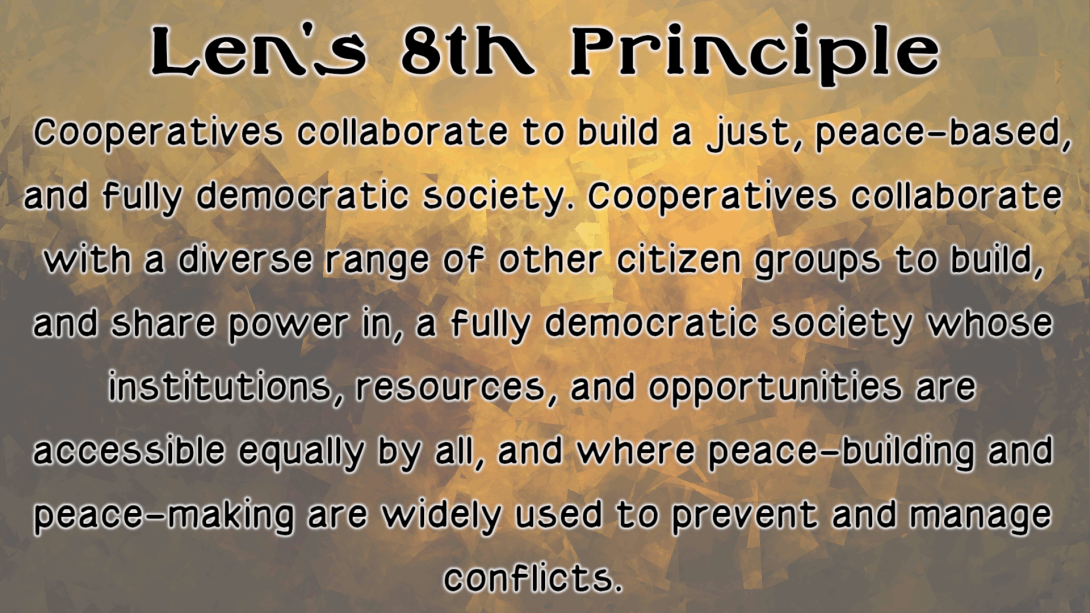
“Cooperatives collaborate to build a just, peace-based, and fully democratic society. Cooperatives collaborate with a diverse range of other citizen groups to build, and share power in, a fully democratic society whose institutions, resources, and opportunities are accessible equally by all, and where peace-building and peace-making are widely used to prevent and manage conflicts.”
He received mixed reactions, and his idea never was adopted. In an article planning GEO’s Advancing the Development of Worker Cooperatives III in 2015, Len made his case again arguing that:
“cooperative growth requires more than cooperatives supporting other cooperatives, and that regional cooperative organizations can play a major role in overcoming growth indifference within our cooperative movement. But to do so, as I see things, they must take a major role in facilitating collaborations not only within but outside the co-op family. If we want a fully cooperative society, we cannot act alone.”
However, his ideas continues to inspire us to think more broadly and inclusively about cooperatives and their roles. And in the 2020s there is a new movement for an 8th cooperative principle about diversity and inclusion.
Also a member of the International Institute of Self Management (IIS), with Frank Lindenfeld, Michael Howard, and Bob Stone, Len worked with members from all over the world advocating for worker control. “A key aspect of the IIS involved visits to cooperative enterprises in whatever country we met in, including self-managed enterprises in the former Yugoslavia, the famous cooperative network in Mondragon, and similar forms of economic democracy in Germany, England, Hungary, Italy, Mexico, Cuba, and elsewhere,” said Michael Howard who was the group’s treasurer from 1990 and 202.
Michael Howard, professor emeritus at the University of Maine and author of the 2000 book, Self-management and the Crisis of Socialism, first met Len in 1980 in Oxford where they both presented papers. Howard remembers:
“Conversations with Len, and others in the IIS were profoundly important influences on my work throughout the decade that I worked on that book. Len was a colleague and comrade in the best senses of the words. He was kind, supportive, funny, irreverent, and asked deep critical questions. I can't imagine my intellectual development unfolding as it did without him.”
Len was a scholar activist who not only studied economic democracy, but also taught it, helped people to organize worker cooperatives; and advocated for worker co-ops and democratic workplaces. He involved his students in all that he did.
Noemi Gizpenc, when she was executive Director of The Cooperative Development Institute, said Len was a board member of CDI, and passionate about developing worker cooperatives, and an active organizer in his town of Willimantic, CT. Willimantic was identified as a potential hub of cooperative enterprise as rural poverty was entrenched in the area, once a mill town where the major industry had closed down. “I will always remember Len's zeal for workplace democracy, which inspired us all,” she said.
Len’s work inspiring people did not just affect people in other organizations, but also GEO members themselves.
GEO member Abe Gruswich, who recently earned a master’s degree in Cooperative Management at St. Mary’s University in Canada, remembers him this way:
“Len was such a pivotal mentor in my life. He was the first person to introduce me to cooperatives. He would drive me to GEO meetings in NY from Connecticut, where I lived at the time. He handed me books and articles to read and the GEO crew threw me right into interviewing folks in the co-op world. I remember feeling so grateful for how supportive he was and how willing he was to share his knowledge. He was both willing to challenge someone's thinking, but would never put someone down for not knowing something. He was kind, driven, and he had such a great smile.”
Jessica Gordon-Nembhard, author of Collective Courage: A History of African American Cooperative Economic Thought and Practice, and colleague in the GEO Collective remembers:
“Len lived and breathed worker cooperatives - always thinking about worker self-directed collective ownership and economic democracy; always teaching about it and advocating for it. He is one of the few academics who also started and ran at least one worker co-op. Len was not just a teacher and a learner, but also a visionary and a doer.”
In 2015 Len decided to write his memoir as a series of articles on GEO’s website. We’ve compiled the series, “Coming Alive in Dangerous Times: A Divergent Memoir” into a collection on our website (or get the PDF version).
With his memoir he urged people to write their own stories to heal themselves, inspire each other, and create economic democracy - and otherwise change the world. We are inspired, Len. Rest in Power! Your legacies live on, and you will never be forgotten.
-The GEO Collective
Citations
GEO Collective (2026). Memories of Len Krimerman from the Grassroots Economic Organizing Collective. Grassroots Economic Organizing (GEO). https://geo.coop/articles/memories-len-krimerman-grassroots-economic-organizing-collective
Comments
Bruce Reynolds
May 8, 2026, 3:09 pm
Wish there had been opportunities for me to have had conversations with Len.
Add new comment