
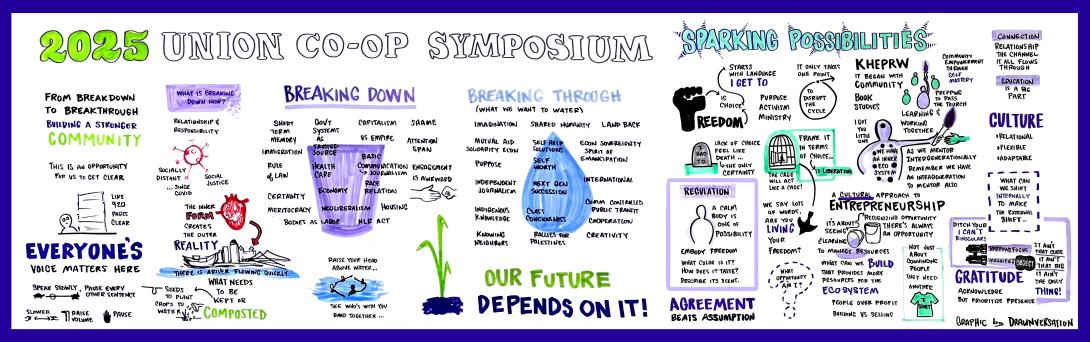
The 7th Union Co-op Symposium, a gathering of worker-owners and union members from across the US, opened with guests being invited to talk to someone they don't know. Facilitators repeat this exercise two or three times in a row to begin the biennial event.
“It is actually really hard to shut it down once you get it started, because so many people are so excited,” says Kristen Barker, a co-director of Co-op Cincy, which has hosted the Symposium since 2013.
The 2025 Symposium took place from October 17-18, offering workshops, panels and conversations on how the cooperative and labor movements can work together to build a democratic economy. This year’s theme was From Breakdown to Breakthrough, focusing on how we can meet this moment of system breakdown with cooperative solutions. The gathering always features speakers from Spain’s Mondragon corporation, and this year included organizers from Argentina and Turkey, highlighting how to navigate authoritarianism while building the social solidarity economy.
Guests participated in a grounding exercise around identifying what is currently breaking down and what ideas they want to see break through, followed by a keynote conversation titled “Sparking Possibilities”, with Black futurist Chinyelu Mwaafrika and Licensed Professional Counselor Shanda Sugg. In keeping with the theme of breakthrough, Kristen recounts how Shanda emphasized focusing on what we want to build, “inviting us to recognize our level of freedom, our level of autonomy and self-determination and what we can consent to in any moment.” This idea resonated throughout the weekend, she says, with people bringing it up in many of the breakout sessions.
The proven power of collaboration between unions and worker co-ops has guided Co-op Cincy since its founding in 2011. Dedicated to building and supporting Greater Cincinnati’s growing network of worker-owned businesses, their work is inspired by the business model of Mondragon International, the world’s largest federation of worker cooperatives. Based in the Basque Region of Spain, where the population size is roughly the same as Greater Cincinnati, Mondragon has reduced unemployment in the area to 4% through job creation, fair wages, and social responsibility since its inception in the aftermath of the Spanish Civil War.
In October 2009, Kristen and labor organizer Ellen Vera—now a co-director of Co-op Cincy—both heard from a mutual friend, Phil Amadon, who was active in the labor movement that the United Steelworkers had just made its historic partnership with Mondragon. The two entities signed an agreement to bring the Mondragon model of “one worker, one vote” to Cincinnati by establishing unionized, worker-owned manufacturing businesses. Together, Kristen and Ellen, and Phil decided to form a study group on Mondragon, joined by immigrant rights organizer Flequer Vera—now Co-op Cincy’s vice president, whom Ellen later married. For the next year, the group spent many late nights at Kristen’s house learning about the Mondragon project and its unique governance structure where the worker-owners of each co-op elect their management team and a union committee to collectively bargain with the management.
In her prior role as the non-violence coordinator at the Intercommunity Justice and Peace Center, Kristen supported a variety of people, including some convicted of felonies, in de-escalating situations through non-violent communication. The work got her thinking about what it would take to substantially decrease the level of violent crime in Cincinnati, which experienced a spike in the early to mid 00s. “I think that at the root of it is having neighborhoods with affordable housing, and having people have access to jobs with dignity, with voice, with family-sustaining wages.”
“For me it felt like, this is what will systematically support the kind of world I want to live in,” says Kristen. In 2011, the study group reached out to people in their network, including labor, faith, and community organizers, and shared what they believed these ideas could do for Cincinnati, a vision Kristen describes as “a thriving city where violence is not the way of doing things because people have what they need and they're deeply connected to their neighbors.” Having assembled about 35 people who were willing and had time to put towards making this happen, the group connected with Mondragon’s North American delegate at the Ohio Employee Ownership Center and set their plans into motion.
Co-op Cincy, whose network now consists of 15 co-ops, has set a goal to have 80,000 people involved in worker-owned cooperatives and 100% employee-owned ESOPs by 2072, and has four strategies to get there. Their first three are: developing new co-ops through its training program called Co-op U; working with existing companies to support them in selling to their workers; and providing wraparound technical assistance to the businesses in their network. What excites them most about the Mondragon model, according to Kristen, is how they move the needle on income inequality. “That's what we believe is possible, and we believe they did that in part because they're this integrated network of co-ops. They're not just one co-op dealing with the global economy.”
“Our fourth strategy is about recognizing that we're always more powerful together, and that's actually where the Union Co-op Symposium comes in.” The network held the first symposium in 2013, where they brought in people from Mondragon and United Steelworkers, and started having them every two years due to the high level of interest. “They are truly to deepen the community, see what's working. How can we scale that? What are new, interesting ideas we can connect around? How do we further build solidarity and help this world we want to see come into existence?”
This year’s 48 breakout sessions demonstrated how the union co-op model can give workers more power when converting companies to worker-ownership, as well as concepts like participatory management and the Living Organization Framework, a model that helps businesses sustain growth by adapting to changing needs. One session explored how shared services co-ops allow small businesses to support each other by saving on expenses, like the Washington, D.C.’s successful Community Purchasing Alliance. This session also featured Common Ground, a shared services co-op launched by Co-op Cincy in early 2025, where eight small construction companies that are either cooperative, woman-owned or minority-owned come together to bid on jobs, getting bigger projects by combining. The worker-owners shared the lessons and the challenges they have had with coming together.
Guests left the event with action-oriented tools to use in their communities, such as first steps for implementing the Great Game of Business, a form of participatory management, and strategies for working with opposing factors with polarity mapping, and how to navigate conflict through hear-centered communication. Some groups left with questions to consider when beginning a shared services co-op, and ways of working specifically with brokers to facilitate worker-ownership conversions. People who participated in the union co-op sessions got sample collective bargaining agreements and strategies to further engage unions. Unions also left with new strategies for their toolbox, such as including a right of first refusal in collective bargaining agreements to allow workers to buy their companies from the owners.
The feedback Co-op Cincy received from those who attended this year’s Union Co-op Symposium, including the international guests, described how people left with renewed energy after connecting with so many others creating real solutions in this moment of breakdown. Describing the energy and buzz she feels hearing all these people who don't know each other build community and solidarity, Kristen says, “I think part of what I love about this is just watching those deep connections form.”
Citations
Megan McGee (2026). From Breakdown to Breakthough: Reflections on The 2025 Union Co-op Symposium. Grassroots Economic Organizing (GEO). https://geo.coop/articles/breakdown-breakthough-reflections-2025-union-co-op-symposium
Comments
April Doner
January 27, 2026, 4:54 pm
Thank you for this excellent report on this important event, and to the organizers and participants. I appreciate deeply this example of bridging historically less-connected spaces of collective power-building.
One quick possible correction: I believe Chinyelu's actual name is Chinyelu Mwaafrika, and that Kheprw is the name of the organization. (I had the honor of working with Kheprw for awhile in Indy.)
Josh Davis
January 28, 2026, 3:05 pm
Thanks for the catch, April. We've made the correction.
Add new comment