
19 views
Related content
New York taxi drivers launch fundraiser for platform co-op
35 views
The co-op hopes to boost driver income “by returning profits to drivers and establish basic employment rights for workers in the sector” as well as save drivers’ money through a credit union partnership as an alternative to “predatory vehicle financing”.
It will also offer a route back into work for drivers who have been delisted by Uber and Lyft. The co-op accused the platforms of doing this “without due process based on specious and often racially biased customer complaints”.
Uber and Lyft have been contacted by Co-op News for a response to these allegations.
In the longer term, the co-ops says it will “fight for a just, green transition to electric vehicles through a Green New Deal” for the taxi sector.
Read the rest at Co-operative News
Media image

Publication date
Cooperatives and the Sustainable Development Goals
71 views
[C]ooperatives are well-placed to contribute to sustainable development’s triple bottom line of economic, social and environmental objectives plus the governance agenda, not least because they are enterprises that endeavour to meet the economic progress of members while satisfying their socio-cultural interests and protecting the environment. They offer an alternative model for enterprise, with contributions to sustainable development well beyond job creation. Since cooperatives’ share in GDP and total enterprises is relatively small in most countries at present, the promotion and expansion of cooperatives could be an important instrument for achieving the Sustainable Development Goals (SDGs).
This brief highlights the contribution of cooperatives to sustainable development and stimulates discussion on the role of cooperatives in the design and implementation of the Sustainable Development Goals (SDGs) that will succeed the Millennium Development Goals.
Read and download the full report from the International Co-operative Alliance and the International Labour Organization here.
Publication date
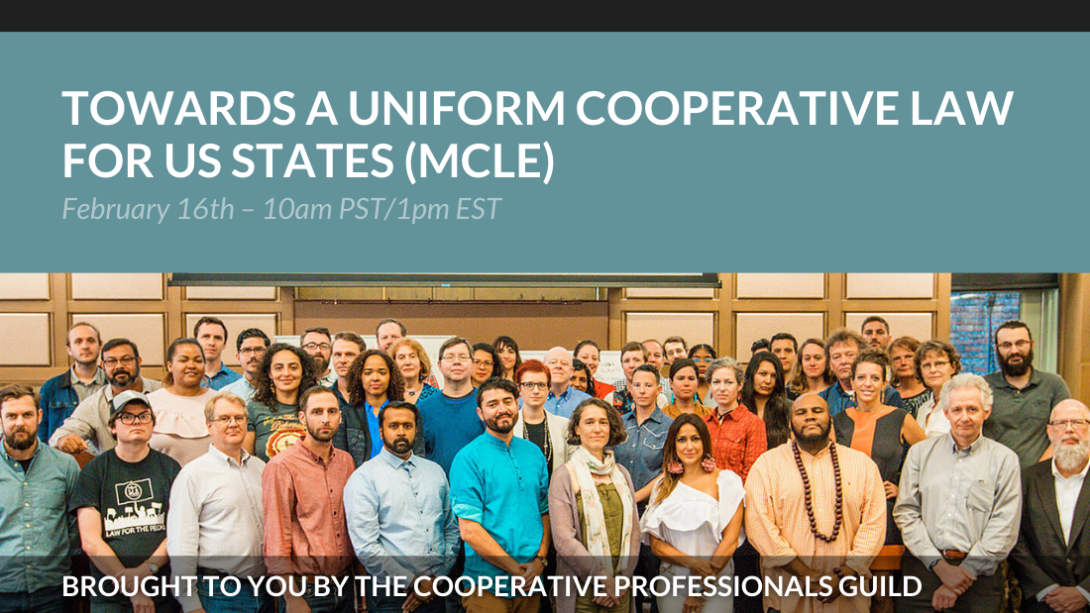
Webinar: Towards a Uniform Cooperative Law
21 views
While uniform state business corporation statutes provide level expectations for enterprises across the United States, the field of cooperative laws is a quirky and often threadbare patchwork quilt. While statutes in a handful of jurisdictions have stayed current with the needs of modern cooperative activity, other state statutes remain grounded in agricultural concepts of the nineteenth century. Operating from the assumption that a new solidarity economy will require a broader and more uniform legal framework for cooperatives, this webinar examines the basis for a uniform cooperative corporation law . How would that be accomplished? What would it contain?
Read the rest and register at The SELC
Media image
Publication date
Report: Expanding New York City's Solidarity Economy
45 views
A vision of a community-led “solidarity economy” is capturing the attention of a new generation of progressive New Yorkers. Seeking to address the ecological, economic, and political crises of our time, local groups are reinvigorating cooperative economic models and inventing new ones, putting into action a vision for an economic system that is based on values of social and racial justice, ecological sustainability, cooperation, mutualism, and democracy. They are creating and sustaining worker cooperatives, community development credit unions, community land trusts, low-income housing and food co-ops, and community gardens -- strengthening neighborhoods, making them more resilient, and meeting community needs.
Together, these efforts offer a pragmatic vision for grassroots, community-led economic development that benefits all New Yorkers. Through democratically-structured local institutions, marginalized New Yorkers, in particular, including low-income immigrants, women, and people of color, are gaining control over their workplace, housing, finance, land use, and food. They are also building a movement, as new leaders develop democratic decision-making skills needed to challenge systemic poverty and oppression.
Read the full report from the Cooperative Economics Alliance of New York City (CEANYC) here
Go to GEO's home page
Media image
Publication date
Add new comment